The 2025 Snapshot
In Fiscal Year 2025:
- 2,278 Patent Bar exams were administered
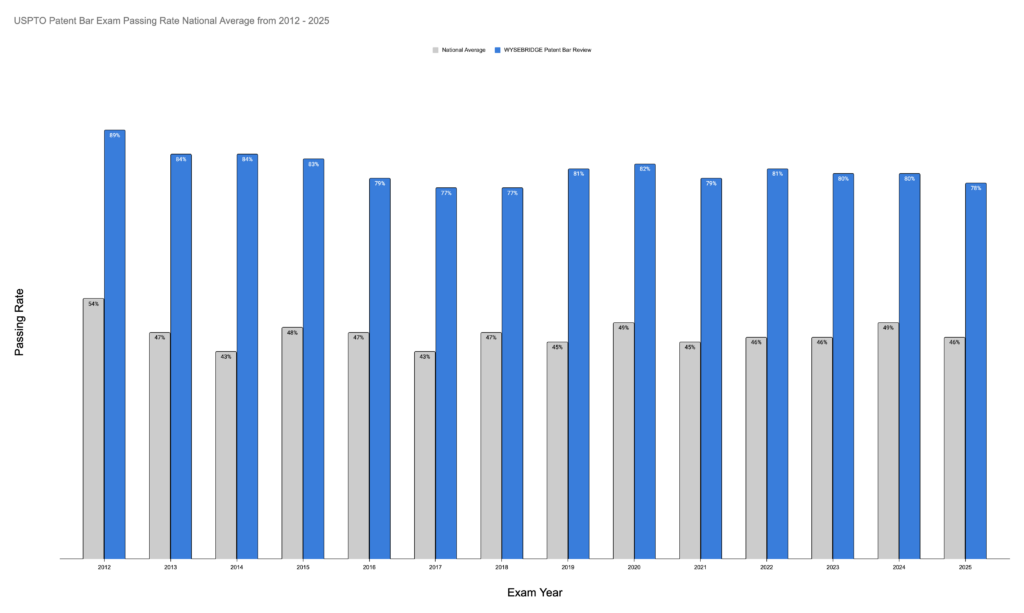
- The national pass rate was 46%
The Long View: What 13 Years of Data Reveal
When you zoom out beyond any single year, this exam has remained consistent. Consistently one of the “hardest” bars to pass. Or rather, consistently maintains a roughly 50% passing rate.
From 2012–2025:
- The national average pass rate is 47%
- Most years fall tightly between 45% and 49%
Despite changes in:
- The MPEP
- The AIA settling in
- Computer-based testing
- Study resources becoming more abundant
…the outcome has stayed essentially flat.
What this tells us (and what we preach/teach)
The Patent Bar is not a knowledge exam. It is a procedural performance exam.
It does not reward:
- General familiarity with patent law
- Passive study
- Memorization without context
It rewards the ability to think and operate like the USPTO expects you to—under time pressure.
Wysebridge Patent Bar Review in Context
Across the same 13-year period:
- Wysebridge’s average pass rate is 81%
- In 2025 specifically: 78%
That performance gap has held steady across:
- Easy years and harder years
- Large cohorts and small cohorts
- First-time takers and repeat takers
This isn’t about a “good year” or a “strong class.” It’s about alignment.
When preparation matches the exam’s true demands, results follow—consistently.
Why People Fail the Patent Bar (Even After Studying a LOT)
This is the hardest part of the conversation, because most failures are not due to laziness or lack of intelligence (you all have advanced degrees in accelerated subjects).
They are due to misunderstanding what the exam is actually testing.
1. Preparing for Content Instead of Process
Many candidates (and even other programs) study patent law as a subject. The exam tests patent law as a workflow.n If you don’t know how rules interact, override, and sequence in practice, the questions will feel confusing—even when you “know” the material.
2. Relying Too Heavily on Passive Study
Videos, outlines, and summaries feel safe. They do not build exam reflexes.
The Patent Bar demands:
- Fast elimination of wrong answers
- Confident decision-making
- Efficient lookup—not exhaustive lookup
Those skills only develop through active, exam-style practice. No matter what you do, you HAVE to practice (and frankly, practicing is the best way to learn the content as well in your studies).
3. Poor Time and MPEP Management
Almost everyone plans to use the MPEP. Very few practice doing it well.
Common issues:
- Searching entire chapters
- Looking up answers already known
- Spending too long confirming low-yield details
Most failing scores are not “low.” They are just short of passing—and time is usually the culprit. That or they missed a few questions because they didn’t learn the nuances of the exam or exam software.
4. Treating Every Question the Same
Successful candidates learn to triage. Unsuccessful candidates try to win every battle and lose the war. The exam rewards strategic restraint as much as knowledge.
2025 in Perspective
The 2025 results reaffirm something we’ve now seen for years:
The exam is stable. The pass rate is predictable. The failure modes are consistent.T here was no surprise difficulty spike. No easing of standards. No hidden curve.
Looking Ahead to 2026
Based on all available data, here’s what we expect going forward: Pass Rates Will Stay Below 50%. There is no evidence suggesting a shift in USPTO philosophy thus a 45–48% national pass rate remains the most likely outcome.
Procedural Density Will Continue
Expect: Multi-step fact patterns, Close answer choices, Conditional logic (“if / then / unless”). The exam will continue rewarding candidates who understand how the USPTO actually operates and more specifically, how to TAKE the exam (not just learn Patent Law).
The Preparation Gap Will Matter More
As people take the exam, the difference between aligned and misaligned preparation widens. The middle collapses. Those who prepare correctly pass. Those who don’t often miss by a narrow margin – we’re talking only a few points.
What Is the USPTO Patent Bar Exam?
At its fundamental basis, the USPTO Patent Bar Exam is a professional licensing exam. Passing it allows you to represent inventors before the United States Patent and Trademark Office in patent matters.
- It is not a law school exam.
- It is not a test of creativity or policy arguments.
- And it is not about writing essays.
It is a procedural, rules-based exam designed to test whether you can operate competently inside the USPTO system and inside a time constrained environment. That’s it.
What the Exam Actually Tests
The Patent Bar tests how patent prosecution works in practice, not just what patent law says in theory.
Specifically, the exam focuses on:
- USPTO procedures
- How applications are filed, examined, amended, appealed, allowed, or abandoned.
- Deadlines and timelines
- When actions must be taken, what happens if they aren’t, and what options remain.
- Rules and exceptions
- Many questions hinge on a single condition, exception, or timing nuance.
- Process navigation
- Knowing where to find answers in official USPTO materials and applying them correctly under time pressure.
As of September 24, 2025, every question on the exam is drawn exclusively from the following:
- Manual of Patent Examining Procedure (MPEP) Ninth Edition, Revision 01.2024 Published November 2024
- Consolidated Trial Practice Guide – November 2019
- Changes to Representation of Others Before the USPTO – Final Rules April 3, 2013
- Implementation of the Global and IP5 Patent Prosecution Highway (PPH) Pilot Programs
What the Exam Is Not
This is important, because many candidates prepare for the wrong thing.
The Patent Bar is not:
- A test of case law analysis
- A writing exam
- A memorization contest
- A general intellectual property knowledge quiz
You will not be rewarded for broad legal reasoning or theoretical understanding if you cannot apply USPTO procedure precisely.
Exam Format and Structure
The exam is:
- Multiple choice (100 questions – 50 questions per 3 hour segment)
- Computer-based
- Time-limited
- Administered in two sessions (morning and afternoon)
Questions are designed to be:
- Fact-heavy
- Procedurally dense
- Often very close in wording
Many incorrect answers look almost right—which is why preparation needs to emphasize decision-making and elimination, not guessing.
Where and How You Take the Exam
The Patent Bar is administered at official Prometric testing centers.
You:
- Apply through the USPTO
- Receive authorization to test
- Schedule your exam at a Prometric location
- Take the exam on a secure computer under supervised conditions
On exam day:
- You are provided access to the tested USPTO materials in electronic form
- You may search them during the exam
- Time management becomes critical
The ability to quickly locate and apply the right rule often makes the difference between passing and narrowly failing.
Why This Exam Feels So Different
Most professional exams reward familiarity. The Patent Bar rewards precision.
It is designed so that:
- You don’t need to know everything
- But you must know how to find and apply what matters
- Under strict time constraints
- Without second-guessing yourself into running out of time
This is why the national pass rate has stayed around the mid-40% range for over a decade—and why aligned preparation changes outcomes so dramatically.
A Wysebridge Perspective
We tell candidates this often: The Patent Bar isn’t trying to trick you. It’s trying to see if you can function inside a very specific system. Once you understand what the exam is—and what it isn’t—it becomes far less mysterious.
And that clarity is where confidence (and passing scores) come from.
A Final Word From Us
At Wysebridge, we don’t believe the Patent Bar should feel mysterious or arbitrary. The data shows it isn’t.
It’s demanding, precise, and consistent—and when candidates meet it on its own terms, it’s passable.
Our goal has always been simple:
Help candidates understand the exam the way the USPTO understands it.
The results speak for themselves.