Patent Bar Study Plan: 4-Week, 8-Week, and 12-Week Paths (2026)
Whether you have one month or three to prepare, a structured study plan is essential for passing the USPTO Patent Bar Exam. This guide provides proven study schedules for 4-week, 8-week, and 12-week timelines, along with practice exam strategies and MPEP search techniques that successful candidates use to pass on their first attempt.
Choose Your Study Timeline
The right study plan depends on your available time, background knowledge, and learning style. Each timeline below assumes you’re starting from scratch with the Patent Bar Exam material.
4-Week Intensive Plan
Best for: Patent professionals with MPEP familiarity, those with urgent deadlines, or candidates retaking the exam who need focused review.
Time commitment: 30-40 hours per week (full-time dedication)
Pros: Fast-track to exam day, maintains sharp focus, ideal for career transitions
Cons: Demanding schedule, less time for deep mastery, higher burnout risk
8-Week Balanced Plan
Best for: Working professionals, those balancing other responsibilities, or candidates who want thorough preparation without overwhelming intensity.
Time commitment: 15-20 hours per week (manageable alongside work)
Pros: Sustainable pace, time for concept absorption, balanced life-study integration
Cons: Requires consistent discipline over two months
12-Week Comprehensive Plan
Best for: Complete beginners to patent law, those wanting deep understanding, or candidates who prefer a relaxed learning pace.
Time commitment: 10-15 hours per week (comfortable pace)
Pros: Thorough mastery of material, less stressful, time for multiple review cycles
Cons: Longer commitment, risk of losing momentum, knowledge from early weeks may fade
Our Recommendation
The 8-week plan offers the best balance for most candidates. It provides sufficient time to learn the material thoroughly while maintaining focus and momentum. If you have patent experience, consider the 4-week plan. If you’re completely new to patent law or prefer a gentler pace, choose the 12-week plan.
4-Week Intensive Study Plan
This aggressive timeline requires full-time dedication but can work well for candidates with prior patent exposure or those retaking the exam. You’ll cover all essential material while prioritizing high-yield topics that appear frequently on the Patent Bar Exam.
Week 1: Foundation and Priority Topics
Daily time: 6-8 hours
Content Focus:
- Patent basics and types of patents (utility, design, plant)
- MPEP Chapters 100-200: Secrecy, classification, and fees
- Patent Bar requirements and exam format review
- MPEP 700: Examination of applications (high-yield material)
- Begin practice questions from covered chapters
Study Activities:
- Read assigned MPEP sections actively with highlighting
- Create concise outlines or flashcards for key rules
- Complete 30-50 practice questions daily
- Review incorrect answers thoroughly, noting MPEP citations
Goal: Build foundational knowledge and develop MPEP navigation skills
Week 2: Core Examination Procedures
Daily time: 6-8 hours
Content Focus:
- MPEP 2100: Patentability (essential chapter—dedicate extra time)
- MPEP 2200: Citation of prior art and ex parte reexamination
- Office actions, amendments, and responses
- Restrictions and elections
- Appeals and petitions basics
Study Activities:
- Study into 35 USC 101, 102, 103, and 112
- Practice MPEP searching for specific rules (see search strategy)
- Complete 50-70 practice questions daily
- Take first 50-question timed practice exam
- Analyze practice exam results and identify weak areas
Goal: Master core patentability concepts that comprise ~40% of exam questions
Week 3: Special Topics and Procedures
Daily time: 6-8 hours
Content Focus:
- MPEP 600: Parts, form, and content of application
- MPEP 800: Restriction in applications filed under 35 USC 111
- MPEP 1200-1400: Appeal, fees, and international applications
- PCT and foreign filing procedures
- Patent Cooperation Treaty basics
Study Activities:
- Complete remaining MPEP reading
- Focus on high-frequency topics from practice question analytics
- Take second 50-question timed practice exam
- Create summary sheets for complex procedures
- Complete 60-80 practice questions daily
Goal: Complete content coverage and strengthen weak areas identified in practice exams
Week 4: Review and Full-Length Practice
Daily time: 6-8 hours
Study Activities:
- Days 1-2: Review all outlines and weak topics. Drill problem areas with targeted questions
- Day 3: Take full 100-question practice exam under actual exam conditions (6 hours with breaks)
- Day 4: Thoroughly review practice exam—study every incorrect answer and related MPEP sections
- Day 5: Take second full 100-question practice exam
- Day 6: Review second exam and create final one-page summary of most-tested rules
- Day 7: Light review only—rest before exam day
Goal: Build exam stamina, refine search strategy, and enter exam day with confidence
4-Week Plan Success Tips
- Treat studying as a full-time job—maintain consistent daily schedule
- Take brief breaks every 90 minutes to maintain focus
- Track weak areas daily and allocate extra time accordingly
- Don’t skip practice exams—they’re essential for time management
- Prioritize sleep and nutrition to support intensive learning
8-Week Balanced Study Plan
The 8-week plan is our most popular recommendation, providing thorough preparation while remaining sustainable alongside work and other commitments. This schedule allows time for deep learning, multiple review cycles, and adequate practice before taking the Patent Bar Exam.
Weeks 1-2: Foundation Building
Weekly time: 15-20 hours (2-3 hours daily)
Content Focus:
- Understanding the Patent Bar Exam format and structure
- Review eligibility requirements to confirm registration readiness
- Introduction to patents and patent types
- MPEP structure and navigation fundamentals
- MPEP Chapters 100-200: Introduction, secrecy orders, classification
- Patent fees and deposit accounts (MPEP 509)
Study Activities:
- Read assigned MPEP sections at moderate pace with active note-taking
- Begin building personal outline or concept map
- Complete 20-30 practice questions daily
- Start flashcard system for key rules and deadlines
- Practice basic MPEP searching techniques
Goal: Establish solid foundation and develop efficient MPEP navigation skills
Weeks 3-4: Core Examination Procedures
Weekly time: 18-22 hours
Content Focus:
- MPEP 600: Parts, form, and content of application (critical chapter)
- MPEP 700: Examination of applications (high-yield material)
- Office actions: Types, responding, amendments
- Filing dates and effective filing dates
- Drawings and specification requirements
Study Activities:
- Create detailed outlines for Chapters 600 and 700
- Complete 30-40 practice questions daily
- Take first 50-question timed practice exam (end of Week 4)
- Review all incorrect answers with MPEP references
- Begin identifying personal weak areas for targeted study
Goal: Master fundamental examination procedures that form the core of the exam
Weeks 5-6: Patentability and Prior Art
Weekly time: 18-22 hours
Content Focus:
- MPEP 2100: Patentability (essential chapter—allocate maximum time)
- 35 USC 101: Patentable subject matter
- 35 USC 102: Conditions for patentability; novelty
- 35 USC 103: Non-obvious subject matter
- 35 USC 112: Specification and claims
- MPEP 2200: Citation of prior art and ex parte reexamination
Study Activities:
- Deep study of the four key statutory sections (101, 102, 103, 112)
- Practice distinguishing between different types of rejections
- Complete 35-45 practice questions daily
- Take second 50-question timed practice exam (end of Week 6)
- Analyze performance trends across both practice exams
Goal: Achieve mastery of patentability concepts that represent ~40% of exam questions
Week 7: Special Topics and Procedures
Weekly time: 18-22 hours
Content Focus:
- MPEP 800: Restriction practice
- MPEP 1200: Appeal
- MPEP 1400-1500: International applications and the Patent Cooperation Treaty
- Post-grant proceedings
- Special application types (provisional, reissue, reexamination)
- Ethics and professional responsibility
Study Activities:
- Complete all remaining MPEP reading
- Focus extra time on identified weak areas
- Complete 40-50 practice questions daily
- Take third 50-question timed practice exam
- Update personal outlines with gap areas
Goal: Complete content coverage and address all weak areas before final review week
Week 8: Final Review and Practice Exams
Weekly time: 20-25 hours
Study Activities:
- Day 1-2: Comprehensive review of all outlines, flashcards, and weak topics
- Day 3: Take first full 100-question practice exam (6 hours, simulating actual exam conditions)
- Day 4: Thorough review of practice exam—study every question, especially incorrect answers
- Day 5: Targeted practice on question types you struggled with
- Day 6: Take second full 100-question practice exam
- Day 7: Light review of most-tested concepts and final MPEP navigation practice—rest well before exam
Goal: Build exam-day confidence, perfect timing strategy, and refine MPEP search skills
8-Week Plan Success Tips
- Schedule study blocks at the same time each day to build routine
- Use weekends for longer study sessions and practice exams
- Join or form a study group for accountability and discussion
- Track your practice question performance to identify patterns
- Review weak areas twice as much as strong areas
- Take at least one full practice exam per week in Weeks 6-8
12-Week Comprehensive Study Plan
The 12-week plan offers the most thorough preparation approach, ideal for candidates new to patent law or those who prefer a comfortable learning pace. This extended timeline allows for deep understanding, multiple review cycles, and reduced study stress while preparing for the Patent Bar Exam.
Weeks 1-3: Introduction and Foundation
Weekly time: 10-15 hours (1.5-2 hours daily)
Content Focus:
- Patent system overview and history
- Types of patents (utility, design, plant) in detail
- Understanding the Patent Bar Exam structure
- Confirm eligibility requirements are met
- MPEP organization and how to navigate effectively
- MPEP Chapters 100-200: Secrecy, classification, national security
- USPTO fees and payment procedures
Study Activities:
- Read material thoroughly without rushing—focus on comprehension
- Begin systematic outline creation
- Complete 15-25 practice questions daily
- Start flashcard system for fundamental concepts
- Practice MPEP table of contents navigation
Goal: Build solid foundational understanding without information overload
Weeks 4-6: Application Filing and Form
Weekly time: 12-16 hours
Content Focus:
- MPEP 600: Parts, form, and content of application
- Specification requirements in detail
- Claims drafting fundamentals
- Drawing requirements and standards
- Abstract and title requirements
- Filing dates and receipt procedures
Study Activities:
- Create detailed Chapter 600 outline
- Study sample patent applications
- Complete 20-30 practice questions daily
- Take first 50-question practice exam (end of Week 6)
- Review practice exam thoroughly with MPEP lookups
Goal: Understand application requirements thoroughly before moving to examination procedures
Weeks 7-8: Examination Procedures
Weekly time: 12-16 hours
Content Focus:
- MPEP 700: Examination of applications (critical chapter)
- Office action types and procedures
- Examiner’s duties and authorities
- Responding to office actions
- Amendments: Types, timing, and format
- Interview practice and procedures
Study Activities:
- Outline Chapter 700 systematically
- Practice identifying office action types from examples
- Complete 25-35 practice questions daily
- Take second 50-question practice exam (end of Week 8)
- Compare performance across both practice exams
Goal: Master examination procedures that appear frequently on the exam
Weeks 9-10: Patentability Deep Dive
Weekly time: 14-18 hours
Content Focus:
- MPEP 2100: Patentability (allocate maximum study time—this is essential)
- 35 USC 101: Patentable subject matter and exceptions
- 35 USC 102: Novelty and prior art
- 35 USC 103: Obviousness analysis
- 35 USC 112: Written description, enablement, definiteness
- MPEP 2200: Prior art citation and examination
Study Activities:
- Deep study of all patentability statutory sections
- Create comparison charts for different rejection types
- Practice distinguishing 102 vs. 103 rejections
- Complete 30-40 practice questions daily
- Take third 50-question practice exam (end of Week 10)
Goal: Achieve expertise in patentability—the most heavily tested topic area
Week 11: Special Topics and Procedures
Weekly time: 14-18 hours
Content Focus:
- MPEP 800: Restriction in applications
- MPEP 1200: Appeal procedures
- MPEP 1400-1500: PCT and international applications
- Reissue, reexamination, and supplemental examination
- Provisional applications
- Ethics and professional responsibility rules
Study Activities:
- Complete all remaining MPEP chapters
- Focus on weak areas identified in practice exams
- Complete 35-45 practice questions daily
- Take fourth 50-question practice exam
- Create final summary sheets for complex topics
Goal: Complete content coverage and shore up all knowledge gaps
Week 12: Review and Full-Length Practice
Weekly time: 18-22 hours
Study Activities:
- Days 1-2: Comprehensive review of all outlines, notes, and flashcards
- Day 3: Take first full 100-question practice exam under actual exam conditions
- Day 4: Thorough review of practice exam—study every question and answer explanation
- Day 5: Focused practice on your remaining weak areas
- Day 6: Take second full 100-question practice exam
- Day 7: Light review of high-frequency topics—rest and prepare mentally for exam day
Goal: Enter exam day with confidence, refined search skills, and optimal mental preparation
12-Week Plan Success Tips
- Maintain consistent study schedule to avoid losing momentum
- Review previous weeks’ material regularly to combat forgetting
- Build in buffer time for life events that may disrupt study
- Start taking practice exams by Week 6 to get early feedback
- Use the extended timeline to truly master difficult concepts
- Don’t let the long timeline cause complacency—stay disciplined
Practice Exam Strategy
Practice exams are the single most important element of your preparation beyond studying the MPEP itself. They help you build timing skills, identify weak areas, develop search strategies, and build exam-day confidence. Here’s how to maximize their value.
When to Take Practice Exams
Early Practice (After ~25% of study time)
Take your first 50-question practice exam once you’ve completed foundational chapters. This early assessment helps you:
- Understand question format and difficulty level
- Identify knowledge gaps before they become ingrained
- Calibrate your study pace and priorities
- Practice basic MPEP navigation under time pressure
Mid-Preparation Practice (After ~50-75% of study time)
Take multiple 50-question practice exams as you complete major content areas. These help you:
- Test retention of earlier material while learning new content
- Refine your MPEP search techniques
- Build speed and accuracy progressively
- Track improvement and maintain motivation
Final Practice (Last 1-2 weeks)
Take at least two full 100-question practice exams under actual exam conditions during your final preparation week. These crucial sessions:
- Build stamina for the 6-hour exam (including breaks)
- Finalize your time management strategy
- Identify any remaining weak areas for last-minute review
- Build confidence through full-length exam experience
How to Take Practice Exams
Simulate Real Exam Conditions
For full-length practice exams, replicate actual exam conditions as closely as possible:
- Environment: Quiet room with computer and MPEP PDF access
- Timing: Use actual exam timing (approximately 3.6 minutes per question)
- Materials: Only MPEP, scratch paper, and calculator (as allowed on actual exam)
- Breaks: Take realistic breaks as you would on exam day
- Focus: No distractions—treat it as seriously as the actual exam
Strategic Approaches During Practice
- First pass: Answer questions you know immediately (under 1 minute each)
- Second pass: Tackle questions requiring MPEP searches
- Final pass: Address most difficult or time-consuming questions
- Flagging: Mark questions you’re unsure about for review if time permits
How to Review Practice Exams
The review process is more important than taking the exam itself. Proper review transforms practice exams into powerful learning tools.
Immediate Review (Same Day)
- Score and assess: Calculate your score and note overall performance
- Review every question: Don’t just review incorrect answers—study every question
- Incorrect answers: Understand why you got it wrong and find the correct MPEP citation
- Correct answers: Verify you got it right for the right reasons
- Lucky guesses: Treat these as incorrect—learn the actual rule
- Document patterns: Track which MPEP chapters or topics cause the most difficulty
- Update study materials: Add missed rules to your outlines or flashcards
Pattern Analysis
After each practice exam, analyze your performance by category:
- Which MPEP chapters produced the most errors?
- What types of questions are most challenging (procedural, statutory interpretation, calculation)?
- Are you making timing errors (rushing and misreading, or going too slowly)?
- Are search skills the issue, or is it content knowledge?
Follow-Up Study
Dedicate focused study time to weak areas identified in practice exams:
- Re-read relevant MPEP sections thoroughly
- Complete additional practice questions on weak topics
- Create summary sheets for repeatedly missed rules
- Practice MPEP searches for topics you struggled to locate
Practice Exam Scoring Benchmarks
Understanding what scores mean helps you gauge your readiness:
Below 60%
Status: Not yet ready—significant improvement needed
Action: Return to systematic content study. You may be taking practice exams too early, or need to strengthen foundational knowledge before continuing practice.
60-69%
Status: Approaching readiness—close but not quite there
Action: Identify and focus on specific weak areas. Increase practice question volume and take additional practice exams. You’re close—targeted study will get you over the threshold.
70-79%
Status: Likely ready—passing range with room for exam-day variation
Action: Continue practice exams and fine-tune search strategy. Focus on consistency across multiple practice exams. Consider scheduling your exam.
80%+
Status: Well prepared—strong passing likelihood
Action: Maintain skills with continued practice. Focus on timing optimization and maintaining accuracy under pressure. You’re ready—schedule your exam with confidence.
Important Considerations
- Passing score on the actual Patent Bar Exam is 70% (70 out of 100 questions)
- Practice exam difficulty varies by source—some are harder than the actual exam
- Consistency across multiple practice exams is more important than a single high score
- If your scores are stagnant, change your study approach rather than just taking more practice exams
- Most candidates improve 5-10% between their final practice exam and actual exam (due to reduced anxiety and focused review)
MPEP Search Strategy
Efficient MPEP searching is a critical skill that separates passing candidates from failing ones. The Patent Bar is an open-book exam, which means success depends on your ability to quickly locate the correct information in the MPEP. Here’s how to master this essential skill.
Understanding the MPEP Structure
Before developing search strategies, you need to understand how the MPEP is organized:
MPEP Organization Hierarchy
- Chapters: Numbered 100-2800, organized by topic (e.g., Chapter 700 = Examination)
- Sections: Within chapters (e.g., 706 = Rejection of Claims)
- Subsections: Detailed rules within sections (e.g., 706.03 = Rejection Under 35 USC 112)
Most Frequently Tested MPEP Chapters
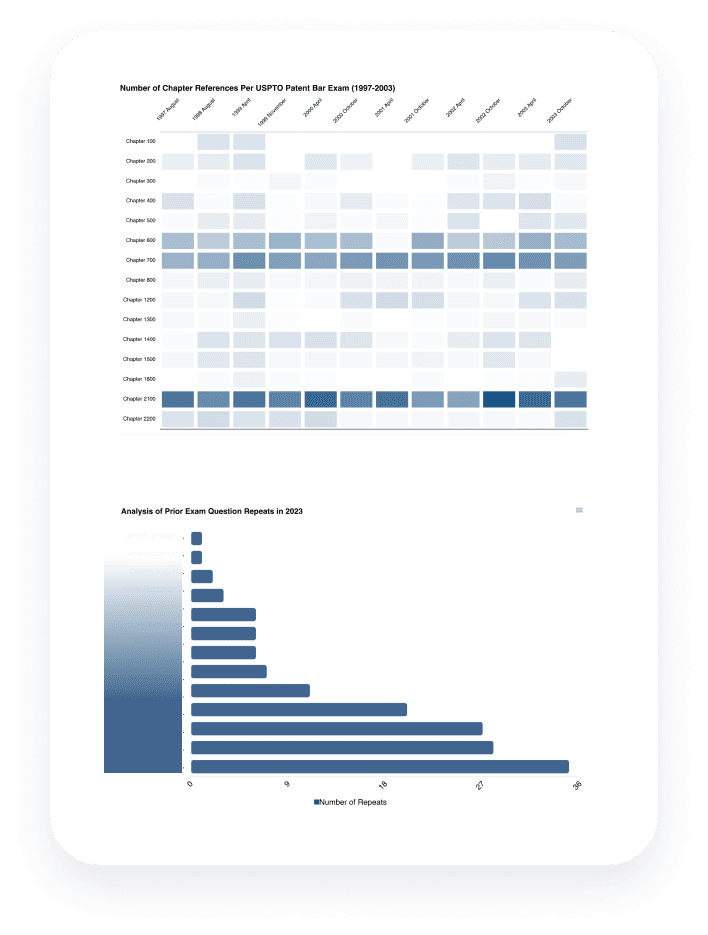
- MPEP 2100: Patentability (~25-30% of exam questions)
- MPEP 700: Examination of Applications (~20-25% of exam questions)
- MPEP 600: Parts, Form, and Content of Application (~15-20% of exam questions)
- MPEP 2200: Citation of Prior Art (~10-15% of exam questions)
- MPEP 800: Restriction Practice (~5-10% of exam questions)
Knowing these high-frequency chapters helps you prioritize which areas to master for quick navigation.
Essential Search Techniques
1. Table of Contents Method (Primary Strategy)
Best for: Most questions, especially when you know the general topic area
How it works:
- Identify the general topic from the question (e.g., “amendments,” “office actions,” “prior art”)
- Navigate to the relevant chapter using the MPEP table of contents
- Scan section titles within that chapter
- Click into the most relevant section
- Use browser find (Ctrl+F/Cmd+F) within the section for specific terms
Example: Question about responding to a 112(a) rejection → Navigate to Chapter 2100 → Section 2163 (Guidelines for Examination of Patent Applications Under 35 USC 112)
2. Keyword Search Method (Secondary Strategy)
Best for: Specific terms, unusual topics, or when Table of Contents navigation isn’t working
How it works:
- Identify unique, specific keywords from the question
- Use the MPEP’s search function (or browser find if using PDF)
- Search for the most distinctive terms first
- Scan results quickly for relevant sections
- Verify the found rule matches the question context
Keyword selection tips:
- Use specific technical terms (e.g., “transitional phrase” not “claim language”)
- Search for exact numbers or deadlines (e.g., “six months”)
- Look for procedural terms (e.g., “petition,” “traverse,” “appeal brief”)
- Use statutory citations when mentioned (e.g., “35 USC 119”)
3. Index Method (Tertiary Strategy)
Best for: Obscure topics or when other methods fail
How it works:
- Navigate to the MPEP index (usually at the end of the document)
- Look up key terms alphabetically
- Follow the provided section references
- Jump to the cited sections
Note: This method is slower but comprehensive—use it as a backup when quicker methods don’t work.
Building Search Speed
Speed develops through practice and familiarity. Here’s how to accelerate your search skills:
Memorize High-Frequency Locations
Create mental bookmarks for the most commonly tested topics:
- 35 USC 101/102/103 rejections: MPEP 2100 series
- 35 USC 112 rejections: MPEP 2160-2180
- Office action responses: MPEP 714
- Amendment procedures: MPEP 714.16
- Restriction practice: MPEP 800 series
- PCT procedures: MPEP 1800 series
- Fees: MPEP 509
- Drawings: MPEP 608.02
Practice Timed Searches
During study sessions, time yourself finding specific rules:
- Set a 2-minute timer
- Search for a specific MPEP rule or answer
- Track whether you found it within the time limit
- Note which method you used and how long it actually took
- Identify faster routes for next time
Develop Pattern Recognition
Learn to recognize question types and their typical MPEP locations:
- Questions about claim language → Usually MPEP 2100 or 600
- Questions about deadlines → Often MPEP 700 series
- Questions about fees → MPEP 509
- Questions about foreign applications → MPEP 1400 or 1800
Search Efficiency Tips
- Don’t read everything: Scan for the specific information the question asks for
- Use browser find (Ctrl+F): Once in the right section, search for specific terms within that page
- Trust the MPEP structure: Sections are logically organized—if something seems misplaced, you’re probably in the wrong section
- Bookmark frequently visited sections: Use your PDF reader’s bookmark function or browser favorites
- Know when to move on: If you’ve spent 3+ minutes searching and haven’t found it, make your best guess and flag for later
- Verify context: Always read surrounding sentences to ensure the rule applies to your question’s scenario
- Practice with official MPEP format: Familiarize yourself with whichever MPEP version (online vs. PDF) you’ll use on exam day
Common Search Mistakes to Avoid
- Searching too broadly: “Patent” will return thousands of results—use specific terms
- Not using section headers: Headers provide crucial context about content
- Stopping at first result: Verify you’ve found the most relevant section, not just any mention
- Over-relying on one method: If Table of Contents isn’t working, switch to keyword search
- Reading too much: You’re looking for specific rules, not comprehensive understanding during the exam
- Forgetting to confirm: Always verify the found rule actually answers the question asked
MPEP Navigation During the Exam
On exam day, your search strategy should be:
- Attempt from memory first: If you know the answer confidently, select it (saves time)
- Quick search for verification: If 80% sure, do a fast search to confirm (1-2 minutes)
- Thorough search for uncertain questions: If unsure, invest time to find the answer (up to 4 minutes)
- Strategic flagging: If search isn’t working, flag and move on—return if time permits
Critical Reminder
The Patent Bar is designed to be passable with MPEP access, but success requires efficient searching. Candidates who fail often know the material but can’t find information quickly enough. Practice your search skills as intensively as you study content—both are equally important.
Adjusting Your Study Plan
No study plan survives contact with reality unchanged. Life happens, learning speeds vary, and individual circumstances differ. Here’s how to adapt your plan while staying on track to pass the Patent Bar Exam.
When to Extend Your Timeline
Consider adding more time if:
- You’re consistently scoring below 60% on practice exams after completing 75% of your study plan
- You’re unable to maintain your planned weekly study hours
- You’re experiencing significant stress or burnout from the current pace
- Major life events (work projects, family obligations) are interfering with study
- You’re finding the material more challenging than anticipated
How to extend: Add 2-4 weeks to your timeline rather than rushing. Better to pass on the first attempt with more preparation than to fail and need to study again.
When to Accelerate Your Timeline
Consider shortening your timeline if:
- You’re consistently scoring 75%+ on practice exams with 2+ weeks remaining
- You have prior patent examination experience or strong familiarity with the MPEP
- You’re retaking after a previous attempt and feel confident in most areas
- You’re finding study sessions easier than expected and completing material ahead of schedule
How to accelerate: Reduce timeline by 1-2 weeks maximum. Always take at least two full practice exams before exam day regardless of confidence.
Dealing With Setbacks
Missed Study Days
- One missed day: Make up the content over the next 2-3 days
- Multiple missed days: Add an extra week to your timeline rather than cramming
- Entire week missed: Restart that week’s material fresh rather than rushing through
Low Practice Exam Scores
- Don’t panic—one low score doesn’t mean failure
- Analyze exactly where you struggled (content vs. search skills)
- Dedicate focused time to weak areas before taking another practice exam
- If scores aren’t improving after 3+ practice exams, consider extending your timeline
Loss of Motivation
- Take a scheduled 2-3 day break to reset (build this into your plan)
- Change study environment or methods to refresh approach
- Connect with other candidates or study groups for accountability
- Review your reasons for taking the Patent Bar to reconnect with your goals
- Remember: temporary motivation dips are normal—discipline carries you through
Optimizing Your Personal Plan
Every candidate learns differently. Use these insights to customize your approach:
If You’re a Visual Learner
- Create flowcharts and diagrams for complex procedures
- Use color-coding in your outlines and notes
- Draw concept maps showing relationships between MPEP sections
- Watch video explanations when available
If You’re an Auditory Learner
- Read MPEP sections aloud
- Explain concepts to study partners or even to yourself
- Listen to patent bar podcasts or lectures
- Record yourself explaining difficult topics and replay them
If You’re a Kinesthetic Learner
- Take handwritten notes even if you type your formal outlines
- Use physical flashcards you can sort and organize
- Practice MPEP searching with actual clicking and navigation
- Walk while reviewing material or listening to explanations
Balancing Study With Life
Sustainable preparation requires balance:
- Work-life integration: Schedule study blocks around work commitments, not instead of sleep or family time
- Social commitments: Build in one day per week with reduced or no study to maintain relationships
- Physical health: Maintain exercise routine—it improves focus and reduces stress
- Mental health: Take real breaks, not just “breaks” where you’re thinking about studying
- Sleep: Never sacrifice sleep for study—well-rested learning is exponentially more effective
Remember
Your study plan is a guide, not a prison. Adjust as needed based on your actual progress, life circumstances, and mental state. The goal isn’t to follow a plan perfectly—it’s to pass the exam. If changes increase your likelihood of passing, make them without guilt.
Next Steps: From Plan to Action
You’ve chosen your timeline and understand the strategies—now it’s time to execute. Here’s how to get started:
1. Confirm Your Eligibility
Before investing time in study, verify you meet all Patent Bar requirements. Review the complete eligibility criteria to ensure you’re qualified to sit for the exam.
2. Gather Your Study Materials
- Download or access the current MPEP (official USPTO version)
- Select a reputable prep course or question bank
- Set up your study space with necessary tools (computer, note-taking materials)
- Bookmark essential resources and our Patent Bar Exam Guide
3. Schedule Your Study Time
- Block out specific study times in your calendar for the entire duration
- Treat these blocks as non-negotiable appointments
- Schedule your practice exams in advance
- Set a tentative exam date to create urgency and focus
4. Begin Your First Week
Start with Week 1 of your chosen plan today—not tomorrow, not Monday. The best time to start was yesterday; the second best time is right now. Follow your plan’s Week 1 guidance and build momentum immediately.
5. Track Your Progress
- Keep a simple log of completed chapters and practice question scores
- Note weak areas for additional review
- Track practice exam scores to monitor improvement
- Adjust your plan based on actual progress, not wishful thinking
You Can Do This
Thousands of patent professionals have successfully passed the Patent Bar Exam using structured study plans like those outlined here. The exam is challenging but passable with dedicated preparation. Trust your plan, put in the work, and you’ll join the ranks of registered patent practitioners.
Your journey to becoming a registered patent attorney or agent starts with the first day of study. Begin today, stay consistent, and you’ll be celebrating your passing score before you know it.
get started
Pass the patent bar and become a leading patent practitioner today!

Continuous updates to content
We continue to refine and update our study materials and questions to ensure you are studying exactly what is needed to pass the patent bar exam.

Your personalized Patent Bar Review
Your platform enables you to study at your own pace with real-time data feedback, community support, and more.

Save up to 50% time and money

Expertise and Data Insights
Our patent bar review team has served more than 6000+ individuals pass the patent bar exam. We built Wysebridge.com to help you accelerate your patent and IP law career.