MPEP Guide for the Patent Bar (2026)
MPEP Guide for the Patent Bar: How to Search Fast and Find Answers
Master the Manual of Patent Examining Procedure (MPEP) to ace the USPTO Patent Bar Exam. This comprehensive guide reveals how to navigate the MPEP efficiently, find answers quickly during the exam, and build the search skills that separate passing candidates from those who struggle.
Why MPEP Navigation Skills Determine Your Exam Success
The USPTO Patent Bar Exam is fundamentally an open-book test, but this creates a dangerous illusion. Many candidates assume that having access to the MPEP means they can simply look up answers as needed. This assumption fails catastrophically on exam day.
Consider the math: you have approximately 3 minutes per question on the exam. In that time, you must read the question, understand what’s being asked, search the MPEP, locate the relevant section, read and comprehend the material, eliminate wrong answers, and select your response. If your search takes 90 seconds or more, you’ve consumed half your available time before you’ve even started analyzing the question.
Successful candidates typically spend 30 to 45 seconds searching the MPEP, leaving the majority of their time for critical thinking and answer selection. This speed doesn’t come from memorization—it comes from understanding how the MPEP is organized, knowing where information lives, and having practiced efficient search patterns.
The Critical Difference
Candidates who pass the Patent Bar typically demonstrate three navigation competencies: they know the overall structure of the MPEP and can predict where information should be located, they’ve identified and bookmarked the 20 to 30 sections they’ll reference most frequently, and they’ve practiced search techniques enough that the process becomes automatic under exam pressure. The MPEP contains over 3,000 pages of material across nine chapters and numerous appendices. No one can memorize this volume of information, nor should they try. Instead, your goal is to build mental maps of where information resides and develop the muscle memory to navigate there quickly. This guide will show you exactly how to develop these skills.
How the MPEP is Structured: Understanding the Framework
The Complete Chapter Structure: Your High-Level Map
The MPEP is divided into 29 chapters, each covering distinct aspects of patent examination procedure. Understanding this chapter structure gives you your first navigation advantage—you can immediately narrow your search to the relevant chapters when looking for specific information. While not all chapters are tested equally on the Patent Bar Exam, knowing what each chapter covers ensures you can quickly identify where to look for any given topic.
Chapter 100 – Secrecy, Access, Petitions, and Fees covers preliminary administrative matters including patent application filing, fees, petition practice, and secrecy orders. While not the most frequently tested chapter, it contains critical information about petition procedures under 37 CFR 1.181 and 1.182, which appear regularly on the exam. Key sections include MPEP 103 on processing petitions, MPEP 113 on application filing requirements, and MPEP 140 on fee payment procedures. This chapter also addresses national security classifications and handling of applications that might contain sensitive subject matter.
Chapter 200 – Types and Status of Application; Benefit and Priority Claims addresses different application types, including provisional applications, continuation applications, divisional applications, and continuation-in-part applications. This chapter is heavily tested because it covers priority claims, benefit claims under 35 USC 119 and 120, and the requirements for maintaining filing dates. Sections 201 through 215 explain different application types, while sections 216 through 220 detail priority and benefit claim procedures. Understanding this chapter is essential because questions about continuation practice, provisional applications, and claiming priority appear frequently on exams.
Chapter 300 – Ownership and Assignment handles issues of inventorship and assignment of patent rights. While smaller than other chapters, it’s tested regularly because questions about correcting inventorship, adding or deleting inventors, and assignment requirements appear frequently. MPEP 324 on correcting inventorship errors is particularly important for exam purposes. This chapter also covers ownership disputes, assignment recordation requirements, and the legal presumptions that arise from proper recordation.
Chapter 400 – Representative of Applicant or Owner covers power of attorney, practitioner conduct, and representation before the USPTO. This material is relevant to your future practice and addresses who may represent applicants, how to establish representation, and the standards of conduct for patent practitioners. Questions about practitioner discipline, conflicts of interest, and the scope of representation authority do appear on the exam, making sections like MPEP 402 on grounds for suspension or exclusion worth knowing.
Chapter 500 – Receipt and Handling of Mail and Papers addresses procedural matters like filing dates, certificate of mailing, correspondence with the USPTO, and the handling of various submissions. This chapter contains many technical rules that are tested frequently, particularly around certificate of mailing procedures under MPEP 512 and filing date requirements. Understanding these procedures is essential because seemingly minor procedural errors can have major consequences in practice, including loss of filing dates or priority rights.
Chapter 600 – Parts, Form, and Content of Application is one of the most heavily tested chapters, covering specification requirements, claims, drawings, abstract, disclosure obligations, and the inventor’s oath or declaration. This chapter implements the requirements of 35 USC 112, making it crucial for exam success. MPEP 601 through 609 cover specification requirements, MPEP 608 addresses utility and how to establish it, MPEP 706 covers the inventor’s oath or declaration, and sections 2161 through 2165 address the written description requirement, enablement, and best mode.
Chapter 700 – Examination of Applications is the largest and most frequently tested chapter, covering the entire examination process from initial review through final actions. This chapter addresses patentability requirements under 35 USC 101, 102, 103, and 112, examiner procedures, amendments, interviews, responses to office actions, and various specialized procedures. Nearly every exam will have multiple questions drawing from this chapter, particularly from sections covering rejections, responses to office actions, and examiner procedures. This chapter is subdivided into many sections covering topics like examination guidelines, restriction practice basics, and continuation examination.
Chapter 800 – Restriction in Applications Filed Under 35 U.S.C. 111; Double Patenting covers restriction requirements when an application claims multiple inventions, as well as statutory and nonstatutory double patenting. Understanding when examiners can properly require restriction, how distinctness is determined, and how applicants should respond is important because these questions test both substantive rules and procedural requirements. MPEP 802 through 821 provide the framework for restriction practice, including telephone restriction practice and traversal procedures. The double patenting sections (MPEP 804) address both statutory double patenting under 35 USC 101 and nonstatutory obviousness-type double patenting.
Chapter 900 – Prior Art, Publication, and Information Submission addresses information disclosure statements (IDS), publication of applications, public availability of application files, pre-examination search procedures, and examiner access to prior art. The rules around IDSs have been tested heavily since the changes to 37 CFR 1.97 and 1.98, making this chapter increasingly important. MPEP 901 through 904 cover public availability of applications, while MPEP 609 (technically in Chapter 600 but closely related) provides detailed IDS requirements that are among the most frequently tested topics on the exam.
Chapter 1000 – Matters Decided by Various U.S. Patent and Trademark Office Officials covers which USPTO officials have authority to decide different types of matters, petition procedures, and the scope of review for different decisions. This chapter addresses petitions to the Director under 37 CFR 1.181, petitions to suspend rules under 1.182, and supervisory authority within the USPTO. While tested less frequently than examination chapters, understanding petition practice and which official has jurisdiction over which matters is important for procedural questions.
Chapter 1100 – Statutory Invention Registration (SIR); Pre-Grant Publication (PGPub); Preissuance Submissions covers the now-discontinued Statutory Invention Registration program, the mandatory and voluntary publication of patent applications under 35 USC 122(b), and third-party preissuance submissions under the America Invents Act. The pre-grant publication provisions are particularly important, as questions about when applications are published, how to avoid publication, and the effects of publication appear on exams. The preissuance submission provisions allow third parties to submit prior art and are a relatively recent addition that may be tested.
Chapter 1200 – Appeal covers the entire appeals process to the Patent Trial and Appeal Board (PTAB), including notice of appeal requirements, appeal brief requirements, examiner’s answer, reply brief, oral hearing procedures, and the Board’s decision. This chapter is heavily tested because appeal procedures involve specific timing requirements, content requirements, and procedural rules that must be followed precisely. MPEP 1204 addresses filing the notice of appeal, 1205 covers appeal brief requirements, 1207 discusses the examiner’s answer, and 1209 addresses reply briefs. Understanding these procedural requirements and the regulations in 37 CFR 41 is essential for appeal-related questions.
Chapter 1300 – Allowance and Issue covers what happens after an application is allowed, including the Notice of Allowance, issue fee payment, withdrawn from issue procedures, and the actual issuance of the patent. This chapter addresses the period between allowance and issuance, including procedures for correcting issues discovered during this time and the finality of certain determinations once a patent issues. While tested less frequently than examination chapters, questions about post-allowance procedures and issue fee requirements do appear.
Chapter 1400 – Correction of Patents addresses certificates of correction under 35 USC 254 and 255, which allow for correction of minor errors in issued patents. This chapter explains when certificates of correction are appropriate, how to request them, and what types of errors can be corrected through this mechanism versus requiring a reissue application. Understanding the distinction between corrections (for minor errors) and reissue (for more substantive changes) is important for exam questions involving issued patents.
Chapter 1500 – Design Patents covers the special rules applicable to design patents under 35 USC 171, including what constitutes patentable design subject matter, ornamentality requirements, the distinction between design and utility, claim format for design patents, and examination procedures specific to designs. Design patents have different rules than utility patents in many respects, and questions testing knowledge of these differences appear regularly. Key sections include MPEP 1502 on the definition of a design patent, 1503 on design patent requirements, and 1504 on subject matter that may be claimed.
Chapter 1600 – Plant Patents addresses plant patents under 35 USC 161-164, including what types of plants are patentable, asexual reproduction requirements, specification and claim requirements specific to plant patents, and examination procedures. Plant patents represent a small portion of USPTO practice but are tested on the exam. Understanding what distinguishes plant patents from utility patents claiming plants, and what the special requirements are for plant patent applications, is necessary for plant patent questions.
Chapter 1700 – Miscellaneous covers various topics that don’t fit neatly into other chapters, including reexamination and post-grant proceedings that have been superseded by AIA trial proceedings, miscellaneous patent terms, and certain specialized procedures. This chapter has been significantly reorganized over time as new post-grant proceedings were created under the America Invents Act.
Chapter 1800 – Patent Cooperation Treaty addresses international applications filed under the Patent Cooperation Treaty (PCT), including the international phase, international search and preliminary examination, and most importantly for U.S. practice, entry into the national stage in the United States. MPEP 1821 covers national stage requirements for entering the U.S. from a PCT application, including timing requirements, translation requirements, and fee requirements. PCT questions test understanding of how international applications enter the U.S. system and what requirements must be met. This chapter also covers the U.S. as a Receiving Office for PCT applications.
Chapter 1900 – Protest covers procedures for third parties to submit protests against pending applications, including timing requirements, content requirements, and how protests are considered by the USPTO. While protests are filed relatively rarely in practice, the procedures are tested on the exam. Understanding when protests may be filed, what they must contain, and how they differ from other third-party submission mechanisms is necessary for protest-related questions.
Chapter 2000 – Duty of Disclosure; Information Disclosure Statement; Protest; Pre-Institution Proceedings; Statutory Invention Registration provides comprehensive coverage of the duty of disclosure, information disclosure statement procedures, inequitable conduct considerations, and related topics. This chapter significantly overlaps with and expands upon material in Chapter 900, particularly regarding IDS requirements. The duty of disclosure sections are important for understanding what must be disclosed, who has the duty, and the consequences of failing to disclose material information.
Chapter 2100 – Patentability is one of the most critical chapters for exam preparation, covering all aspects of patentability analysis including utility (35 USC 101), novelty (35 USC 102), nonobviousness (35 USC 103), and the disclosure requirements of 35 USC 112. This chapter contains detailed examination guidelines for determining patentability, including the subject matter eligibility framework from Alice/Mayo, the prior art provisions under the America Invents Act, the Graham factors for obviousness, and the tests for written description, enablement, and best mode. Sections 2106 (eligibility), 2131-2146 (novelty and obviousness), and 2161-2173 (section 112 requirements) are among the most frequently referenced sections during the exam.
Chapter 2200 – Citation of Prior Art and Ex Parte Reexamination of Patents covers citation of prior art to issued patents under 35 USC 301, ex parte reexamination proceedings under 35 USC 302-307, and the procedures for conducting reexamination. While ex parte reexamination has been largely superseded by post-grant proceedings under the AIA, it remains available and is still tested. Understanding when reexamination is available, how it differs from initial examination, and what procedures apply during reexamination is important for reexamination questions.
Chapter 2300 – Interference and Derivation Proceedings addresses derivation proceedings under the America Invents Act, which replaced interference proceedings for applications subject to AIA provisions. Derivation proceedings are used when an applicant believes another party derived the claimed invention from them. While these proceedings are relatively rare in practice, basic knowledge of when they’re available and how they’re initiated may be tested. This chapter also contains historical information about interference proceedings for pre-AIA applications, though these are increasingly less relevant for current exam purposes.
Chapter 2400 – Biotechnology provides specialized examination guidelines for biotechnology inventions, including deposit requirements for biological materials, enablement considerations for biotechnology inventions, written description requirements for genetic material, and patentability of life forms. This chapter addresses the special issues that arise in biotechnology cases, such as when deposit of biological material is required and what deposit procedures must be followed. Questions about biotechnology-specific requirements appear periodically on the exam.
Chapter 2500 – Maintenance Fees covers the requirement to pay maintenance fees on utility patents to keep them in force, including the timing of maintenance fee payments, grace periods, reinstatement procedures if fees are not timely paid, and fee amounts. Understanding maintenance fee requirements, particularly the timing of the three maintenance fee payments (at 3.5, 7.5, and 11.5 years after grant), is important because maintenance fee questions test both timing and procedural requirements.
Chapter 2600 – Optional Inter Partes Reexamination addressed inter partes reexamination under pre-AIA provisions. This proceeding has been replaced by inter partes review under the AIA for most purposes, and inter partes reexamination is no longer available for patents subject to AIA provisions. This chapter is less relevant for current exam preparation as these proceedings are being phased out, though some knowledge may still be tested for patents not subject to AIA provisions.
Chapter 2700 – Patent Terms and Extensions covers patent term adjustment under 35 USC 154(b), patent term extension for regulatory delays under 35 USC 156 (Hatch-Waxman extensions), and terminal disclaimers. Understanding how patent term is calculated, what can extend or reduce patent term, and when terminal disclaimers are required or advisable is important for term-related questions. MPEP 2701-2710 cover patent term adjustment calculations, while later sections address patent term extensions for regulatory review periods.
Chapter 2800 – Supplemental Examination covers supplemental examination proceedings under 35 USC 257, which allow patent owners to request that the USPTO consider, reconsider, or correct information believed to be relevant to the patent. This proceeding was created by the AIA and provides a mechanism for patent owners to address potential inequitable conduct issues. While supplemental examination is filed relatively infrequently, understanding when it’s available and what it can accomplish is necessary for questions about correcting issued patents or addressing disclosure issues.
Chapter 2900 – International Design Applications addresses design applications filed under the Hague Agreement, which provides an international system for design protection similar to how the PCT operates for utility patents. This chapter covers international design application procedures, examination of international design applications designating the U.S., and the relationship between international design applications and regular U.S. design patent applications. This is a more specialized topic but may be tested as international design filings become more common.
Chapter Organization and Numbering Logic
MPEP sections are numbered logically within each chapter. The first digit or digits indicate the chapter (100, 200, 600, 700, 2100, etc.), while subsequent digits indicate the section. For example, MPEP 2106 is in Chapter 2100 (Patentability), section 06. This numbering system helps you navigate because related topics cluster together numerically. Some sections use decimal subdivisions for detailed subtopics. For instance, MPEP 2106.03 addresses eligibility steps for examining claims, while 2106.04 covers specific subject matter categories. Understanding this hierarchical numbering helps you broaden or narrow your search as needed.
The Appendix Structure
The MPEP appendices contain the actual text of statutes, rules, and other reference materials. While the chapter sections explain procedures, the appendices provide the legal foundation. The most important appendices for exam purposes include:
Appendix L contains the full text of Title 35 of the United States Code, the patent statute. When questions ask about statutory requirements, you may need to reference the actual statute rather than the MPEP’s explanation of it. Sections covering 35 USC 101, 102, 103, and 112 are particularly important.
Appendix R contains Title 37 of the Code of Federal Regulations, the patent rules. Many exam questions test specific regulatory requirements, making this appendix essential. Rules 1.53 (application types), 1.78 (continuation practice), 1.97 and 1.98 (information disclosure statements), and 1.181 (petition practice) appear frequently on exams.
Appendix T contains the Manual of Patent Examining Procedure Table of Contents, which can be useful for getting your bearings when you’re unsure where to start searching. Some candidates find that scanning the table of contents helps them identify the right chapter or section when a search isn’t immediately productive.
Other appendices include treaty texts, examination forms, and supplementary materials that are referenced less frequently but can be important for specific types of questions.
How Sections Reference Each Other
The MPEP frequently cross-references related sections. These cross-references are valuable navigation tools because they connect related concepts across different chapters. When you find a relevant section, checking its cross-references often leads you to additional pertinent information or helps you understand the broader context.
For example, MPEP 2163 on the enablement requirement references MPEP 2164 (the written description requirement) and MPEP 2165 (the best mode requirement) because all three are part of 35 USC 112(a). Following these connections helps you understand how different requirements relate to each other and can help you eliminate wrong answers that confuse related but distinct concepts.
Most Frequently Tested Chapters
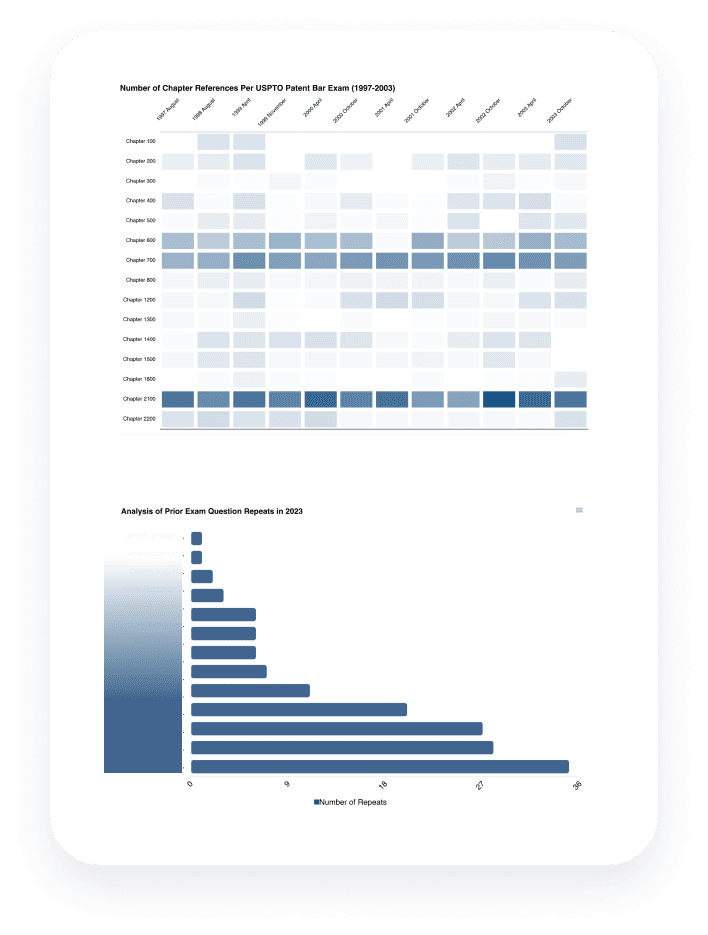
While all chapters can be tested, certain chapters appear far more frequently on the Patent Bar Exam. Understanding which chapters to prioritize in your preparation helps you allocate study time efficiently. The most heavily tested chapters are Chapter 200 (application types and benefit claims), Chapter 600 (specification and disclosure requirements), Chapter 700 (examination procedures), Chapter 800 (restriction and double patenting), Chapter 1200 (appeals), Chapter 2000 (duty of disclosure and IDS), and Chapter 2100 (patentability under 101, 102, 103, and 112).
These chapters form the core of patent prosecution practice and represent the majority of exam questions. While you should have familiarity with all chapters, deep knowledge of these high-frequency chapters is essential for exam success. Questions from Chapter 1500 (design patents), Chapter 1800 (PCT), and Chapter 2700 (patent term) also appear regularly but less frequently than the core examination chapters.
Specialized chapters like Chapter 2400 (biotechnology), Chapter 2800 (supplemental examination), and Chapter 2900 (international designs) are tested less frequently and typically represent a smaller portion of the exam. However, when questions from these chapters do appear, they often test basic knowledge rather than nuanced details, so general familiarity with these topics is usually sufficient.
Understanding the MPEP Search Interface
During the Patent Bar Exam, you’ll access the MPEP through the USPTO’s online interface. This interface provides several search methods: a basic search box, an advanced search option, and navigation through the table of contents. Each method has strengths and weaknesses, and effective candidates use all three depending on the situation.
The basic search box accepts keywords and phrases and returns sections containing those terms. This works well when you know the specific terminology used in the MPEP, but it can be overwhelming if your search returns hundreds of results. The key to effective basic searching is using specific, technical terms rather than general concepts.
For example, searching for “continuation application” will return dozens of sections mentioning this term. However, searching for “1.78” (the regulation number for continuation applications) will take you more directly to the relevant procedural requirements. Learning the regulation numbers for frequently tested topics dramatically improves your search efficiency.
The Power of Regulation Numbers
Perhaps the single most effective search strategy is using regulation numbers from 37 CFR. Many exam questions reference specific regulations, and searching by regulation number often takes you directly to the most relevant MPEP sections. Even when a question doesn’t mention a regulation number, if you can identify which regulation governs the issue, searching by that number is usually faster than keyword searching.
For instance, if a question involves information disclosure statements, searching “1.97” or “1.98” immediately takes you to the relevant regulations and MPEP sections explaining IDS requirements. If a question involves petition practice, searching “1.181” or “1.182” gets you to the right material faster than searching “petition” or “petition to the Director.”
Building a mental index of key regulation numbers should be part of your exam preparation. You don’t need to memorize what each regulation says, but knowing which regulation governs common topics enables much faster searching. Your goal is to see a question and immediately think “that’s a 1.78 issue” or “that’s a 2.142 question.”
Strategic Keyword Selection
When you do use keyword searches, your word choice matters enormously. The MPEP uses specific technical terminology, and searching with the right terms versus the wrong terms can mean the difference between finding your answer in five seconds versus not finding it at all.
Consider an example: if a question asks about adding a new inventor to an application, you might instinctively search “add inventor” or “change inventor.” However, the MPEP uses the term “correct inventorship,” and searching that phrase will be far more effective. Similarly, if you search “patent drawings” you’ll get many results, but searching “37 CFR 1.84” takes you directly to the drawing requirements.
Part of your exam preparation should involve learning MPEP terminology. As you practice with questions, note the specific terms used in the MPEP sections that provide the answers. Build a mental glossary that maps common concepts to MPEP terminology. This glossary becomes your search advantage on exam day.
Using Quotation Marks and Boolean Operators
The MPEP search interface supports quotation marks for exact phrase searching. This is incredibly powerful when you know the precise phrase used in the MPEP. For example, searching “species elected” with quotes will find only sections using that exact phrase, filtering out results that happen to contain both words separately.
Some USPTO search interfaces also support basic Boolean operators like AND, OR, and NOT, though this varies by the specific platform version. If available, these operators let you combine or exclude terms. For instance, “restriction AND election” finds sections discussing both concepts, while “continuation NOT CIP” might help you find information about regular continuations while filtering out continuation-in-part results.
However, don’t overcomplicate your searches with elaborate Boolean queries. Simple, focused searches using precise technical terms usually work better than complex search strings. Save the advanced techniques for when simple searches don’t produce results.
The Table of Contents Navigation Method
Sometimes the fastest way to find information is through the table of contents rather than searching. This is particularly true when you know generally where information should be (for example, “I know this is in the chapter on examination”) but aren’t sure of the exact section or the precise search terms.
The table of contents method works by navigating through the chapter structure until you find your topic. Start with the relevant chapter, scan the section headings, and drill down to more specific subsections. This approach has the advantage of showing you the context around your topic and related sections you might not have found through keyword searching.
For example, if you need information about continued examination practice, you could search keywords, but you might also navigate to Chapter 700 (Examination), then to section 700 (Examination of Applications), then scan the subsections until you find MPEP 706.07 covering requests for continued examination. Along the way, you’ll see related sections about other types of continuation practice, giving you context that might help you answer the question.
Building Your Personal Index
Many successful candidates create a personal quick-reference index during their preparation. This isn’t about memorizing content—it’s about creating a navigation tool you can use during the exam. Your index might list key topics alongside the MPEP sections or regulation numbers where that information is found.
For example, your index might include entries like: “Priority claims – MPEP 213, 35 USC 119,” “Restriction practice – MPEP 802-821,” “IDS requirements – MPEP 609, 37 CFR 1.97-1.98,” “Final rejection – MPEP 706.07(a), 37 CFR 1.113,” and “Appeal brief requirements – MPEP 1205, 37 CFR 41.37.”
While the USPTO doesn’t allow you to bring external materials into the exam, you can access this index during the exam if you’ve created it as bookmarks within the MPEP interface itself. Many exam software systems allow you to bookmark pages, create notes, or mark favorites. Setting up these navigation aids at the beginning of your exam (or during preparation if you have access to a practice system) can save significant time during the actual test.
The Two-Pass Search Strategy
When you’re struggling to find information, employ a two-pass search strategy. First, use a broad search to identify the general area where your answer should be. Then, use a more specific search within that area or manually review the relevant sections.
For example, if a question asks about the requirements for claiming priority to a foreign application, your first pass might search “foreign priority” to identify that this information is in Chapter 200. Your second pass might search “35 USC 119” or navigate through section 213 specifically. This two-pass approach prevents you from getting lost in irrelevant search results while still helping you narrow down to the precise answer.
The two-pass strategy is particularly effective for questions involving multiple concepts. If a question asks about restriction requirements in design patent applications, you might first search “design patent” to understand any special rules for design patents, then search “restriction” within the design patent sections to find the specific intersection of these topics.
Where to Find Index: Essential Topics and Sections
The following index maps the most frequently tested exam topics to their primary MPEP locations. This isn’t comprehensive—the MPEP contains far more information—but these are the sections you’ll reference repeatedly during the exam. Familiarizing yourself with these locations will dramatically improve your search speed.
35 USC 101 (Patent-Eligible Subject Matter)
- MPEP 2106 – Patent Subject Matter Eligibility (the primary section for Alice/Mayo analysis)
- MPEP 2106.03 – Steps for determining eligibility
- MPEP 2106.04 – Specific categories of subject matter (abstract ideas, laws of nature, natural phenomena)
- MPEP 2106.05 – Identifying exceptions to eligibility
- 35 USC 101 – The statute itself (Appendix L)
35 USC 102 (Novelty and Prior Art)
- MPEP 2150 – Patentability under AIA 35 USC 102
- MPEP 2152 – What constitutes prior art (the new AIA categories)
- MPEP 2153 – Prior art exceptions (grace period, disclosures by inventor)
- MPEP 2154 – Prior art under 102(a)(2) (patent applications as prior art)
- MPEP 2155 – Determining the effective filing date
- 35 USC 102 – The statute (note the AIA version versus pre-AIA version)
35 USC 103 (Obviousness)
- MPEP 2141 – Examination guidelines for determining obviousness
- MPEP 2141.01 – Graham factors and Supreme Court precedent
- MPEP 2141.02 – Differences between claimed invention and prior art
- MPEP 2144 – Supporting a rejection with documentary evidence
- MPEP 2145 – Secondary considerations (objective evidence of non-obviousness)
- 35 USC 103 – The statute itself
35 USC 112(a) (Written Description, Enablement, Best Mode)
- MPEP 2161 – Three separate requirements overview
- MPEP 2163 – Enablement requirement in detail
- MPEP 2163.02 – Test for enablement (Wands factors)
- MPEP 2163.04 – Burden of proof for enablement challenges
- MPEP 2164 – Written description requirement
- MPEP 2164.01 – Test for written description (possession standard)
- MPEP 2165 – Best mode requirement
- 35 USC 112(a) – The statute
35 USC 112(b) (Definiteness)
- MPEP 2173 – Definiteness requirement under 35 USC 112(b)
- MPEP 2173.02 – Scope of claim limitations
- MPEP 2173.05(a) – Functional language and means-plus-function claims
- 35 USC 112(b) – The statute
35 USC 112(d) and (e) (Reference to Other Applications)
- MPEP 2163.03 – Incorporation by reference requirements
- 35 USC 112(d) and (e) – The statutory provisions
35 USC 112(f) (Means-Plus-Function Claims)
- MPEP 2181 – Interpreting means- or step-plus-function limitations
- MPEP 2181.01 – Scope of claim limitation
- 35 USC 112(f) – The statute
Continuation Practice (35 USC 120, 121)
- MPEP 201.06 – Continuing applications overview
- MPEP 201.07 – Continuation applications
- MPEP 201.08 – Divisional applications
- MPEP 201.11 – Continuation-in-part (CIP) applications
- MPEP 211 – Claiming benefit of earlier filing date (35 USC 120)
- MPEP 211.01(a) – Requirements for claiming benefit
- 37 CFR 1.78 – The regulation governing continuation practice
- 35 USC 120 – The benefit statute
Provisional Applications (35 USC 119(e))
- MPEP 201.04 – Provisional applications overview
- MPEP 211.01(b) – Claiming benefit to a provisional
- 37 CFR 1.53(c) – Provisional application requirements
- 35 USC 119(e) – The statute
Priority Claims to Foreign Applications (35 USC 119(a)-(d))
- MPEP 213 – Right of priority under 35 USC 119(a)-(d) and (f)
- MPEP 213.01 – Priority claim requirements
- MPEP 213.02 – Priority documents and translation requirements
- 37 CFR 1.55 – Claiming priority
- 35 USC 119(a)-(d) – The statute
Design Patents (35 USC 171)
- MPEP 1500 – Design patents overview
- MPEP 1502 – Definition of design patent
- MPEP 1503 – Requirements for design patents (ornamental, not functional)
- MPEP 1504 – Subject matter that may be claimed
- 35 USC 171 – The design patent statute
Plant Patents (35 USC 161-164)
- MPEP 1600 – Plant patents overview
- MPEP 1601 – Subject matter requirements
- MPEP 1605 – Specification and claim requirements
- 35 USC 161-164 – Plant patent statutes
Reissue Applications (35 USC 251-252)
- MPEP 1401 – Reissue overview
- MPEP 1402 – Grounds for reissue (error without deceptive intention)
- MPEP 1404 – Broadening versus narrowing reissues
- MPEP 1412 – Reissue oath or declaration
- 35 USC 251-252 – Reissue statutes
Reexamination (35 USC 301-307)
- MPEP 2209 – Ex parte reexamination overview
- MPEP 2212 – Filing requirements for ex parte reexamination
- MPEP 2222 – Ex parte reexamination proceedings
- 35 USC 301-307 – Ex parte reexamination statutes
Information Disclosure Statements (37 CFR 1.97-1.98)
- MPEP 609 – Information disclosure statements (primary section)
- MPEP 609.01 – Duty of disclosure to USPTO
- MPEP 609.02 – Time for filing IDS
- MPEP 609.04 – Content of IDS (what must be included)
- 37 CFR 1.97 – Filing of IDS (timing and fee requirements)
- 37 CFR 1.98 – Content of IDS (formatting requirements)
Restriction Requirements (35 USC 121)
- MPEP 802 – Restriction between inventions
- MPEP 802.01 – Philosophical basis for restriction
- MPEP 806 – Determination of distinctness for restriction
- MPEP 809 – Linking claims (provisional election)
- MPEP 812 – Traversing restriction requirement
- MPEP 821 – Manner of making requirement (how examiner issues restriction)
- 35 USC 121 – The statute (divisional applications and safe harbor)
Office Actions (37 CFR 1.104, 1.111)
- MPEP 704 – Office action overview
- MPEP 706 – Rejections, objections, and informalities
- MPEP 706.07(a) – Final rejection requirements
- MPEP 714 – Amendments responding to office actions
- MPEP 714.01 – Format of amendments
- 37 CFR 1.111 – Reply by applicant or patent owner to a non-final office action
- 37 CFR 1.113 – Final rejection or action
Appeals (37 CFR 41.31-41.37)
- MPEP 1200 – Appeals overview
- MPEP 1204 – Filing a notice of appeal
- MPEP 1205 – Appeal brief requirements
- MPEP 1205.01 – Appeal brief content and format
- MPEP 1205.02 – Appeal brief page limits and extensions
- MPEP 1207 – Examiner’s answer
- MPEP 1209 – Reply brief
- 37 CFR 41.31 – Appeal to the Board
- 37 CFR 41.37 – Appeal brief requirements
Request for Continued Examination (RCE) (37 CFR 1.114)
- MPEP 706.07(h) – Request for continued examination (RCE) practice
- MPEP 706.07(h)(1) – When RCE is available
- MPEP 706.07(h)(2) – RCE filing requirements
- 37 CFR 1.114 – The RCE regulation
Petition Practice (37 CFR 1.181-1.183)
- MPEP 1002 – Petitions to the Director overview
- MPEP 1002.01 – Procedure for filing petitions
- MPEP 1002.02 – Petition decisions and judicial review
- 37 CFR 1.181 – Petition to the Director (discretionary action)
- 37 CFR 1.182 – Petition to suspend rules (extraordinary situations)
- 37 CFR 1.183 – Petition to waive provisions
Patent Cooperation Treaty (PCT) Applications
- MPEP 1800 – PCT applications overview
- MPEP 1821 – National stage requirements (entering US from PCT)
- MPEP 1893 – National stage amendments and arguments
- 35 USC 363 – International applications designating the US
- 37 CFR 1.495 – National stage commencement and requirements
Double Patenting
- MPEP 804 – Double patenting rejections
- MPEP 804.01 – Prohibition against double patenting (statutory and nonstatutory)
- MPEP 804.02 – Statutory double patenting
- MPEP 804.03 – Nonstatutory obviousness-type double patenting
- MPEP 1490 – Terminal disclaimers to overcome double patenting
Inventorship (35 USC 116; 37 CFR 1.45-1.48)
- MPEP 2137 – Inventorship overview and examination guidelines
- MPEP 2137.01 – Joint inventorship
- MPEP 324 – Correcting inventorship errors
- 35 USC 116 – Inventors statute
- 37 CFR 1.48 – Correcting inventorship
Oath or Declaration Requirements (37 CFR 1.63-1.64)
- MPEP 602 – Oath or declaration requirements overview
- MPEP 602.01 – Who may execute the oath or declaration
- MPEP 602.02 – Time for filing oath or declaration
- MPEP 602.05 – Substitute statements in lieu of oath or declaration
- 37 CFR 1.63 – Oath or declaration content requirements
- 37 CFR 1.64 – Oath or declaration timing and substitute statements
This index provides starting points for your searches, but remember that many topics span multiple MPEP sections. When you find a relevant section, check its cross-references to locate related material. The goal is not to memorize these locations but to internalize the general areas so you can navigate quickly when you encounter questions on these topics.
Advanced Search Techniques for Exam Day
The Regulation Number Strategy
As mentioned earlier, searching by regulation number is often the fastest way to find information. However, this technique requires knowing which regulations govern which topics. During your preparation, build a mental map of key regulations. You don’t need to know what they say, just what they’re about.
For example, know that 37 CFR 1.53 covers types of applications, 1.78 covers continuations, 1.97 and 1.98 cover information disclosure statements, 1.104 and 1.111 cover office actions and responses, 1.113 covers final rejections, 1.114 covers RCE practice, 1.181-1.183 cover petitions, and so on. With this knowledge, you can often search directly for the regulation number and find your answer immediately.
When a question mentions a specific regulation, that’s an obvious signal to search for it. But even when the question doesn’t mention a regulation, if you can identify which regulation governs the issue, searching by that number is usually more efficient than keyword searching. This is why building your mental regulation map is one of the highest-value preparation activities you can undertake.
Using Form Paragraph Numbers
MPEP sections often reference form paragraphs that examiners use in office actions. These form paragraph numbers (like 7.103 or 7.05.01) can be useful search terms because they’re unique identifiers that appear in specific contexts. If you encounter a question that seems to reference something an examiner would put in an office action, and you can identify or guess the form paragraph number, searching for it can take you directly to the relevant MPEP discussion.
For instance, form paragraph 7.103 relates to restrictions under 35 USC 121. If you encounter a restriction question and search “7.103” you’ll find relevant material about restriction practice. While you shouldn’t try to memorize form paragraph numbers, being aware that they exist and can be used as search terms adds another tool to your arsenal.
The Hierarchical Narrowing Technique
When dealing with complex questions that involve multiple concepts, use hierarchical narrowing. Start with the broadest concept, identify the relevant chapter or major section, then progressively narrow your search within that area.
For example, suppose a question asks about the requirements for filing a reply brief after receiving an examiner’s answer in an appeal. Your hierarchical approach might be: first, recognize this is about appeals (Chapter 1200); second, identify that it’s about reply briefs specifically (not the initial appeal brief or notice of appeal); third, search for “reply brief” within the appeals sections or navigate to MPEP 1209; finally, locate the specific requirements within that section.
This technique prevents you from getting overwhelmed by search results that cover too many unrelated topics. By narrowing progressively, you maintain context and ensure you’re looking at information relevant to all aspects of the question.
Cross-Reference Following
When you find a relevant section, don’t stop reading once you’ve found information that seems to answer the question. Check the section’s cross-references to other MPEP sections. Often, the answer requires information from multiple sections, or the cross-references provide context that helps you eliminate wrong answer choices.
For example, if you’re researching written description requirements and find MPEP 2164, you’ll see cross-references to MPEP 2163 (enablement) and MPEP 2165 (best mode). Even if your question is specifically about written description, understanding how it differs from enablement might be necessary to select the correct answer, especially if some answer choices confuse these distinct requirements.
The Statutory Foundation Technique
Many MPEP sections explain procedures that implement statutory requirements. When you find a relevant MPEP section, note which statute it’s implementing and consider whether you need to check the actual statutory language. Sometimes the question hinges on the precise statutory wording rather than the MPEP’s explanation of it.
For instance, questions about the requirements for claiming benefit to an earlier application often require reference to 35 USC 120 itself, not just the MPEP sections explaining it. The statute contains specific language about what must be present in the specification, and answer choices may test whether you understand the actual statutory requirements versus common misconceptions.
When you’re unsure whether the MPEP explanation is sufficient or whether you need the statute itself, look for answer choices that use statutory language. If answer choices quote or paraphrase statutory text, that’s a signal you should check the actual statute to ensure you’re selecting the option with the most accurate language.
Timing and Fee Tables
The MPEP contains various tables listing fees, time periods, and other numeric information. For questions involving these specifics, search for the relevant table rather than trying to find the information in prose sections. Common tables include fee schedules, priority document requirements, and time period tables for responses and appeals.
For example, if a question asks about the time period for filing a reply brief in an appeal, rather than searching through the appeals sections for this specific detail, you might search for “time period” combined with “reply brief” to find the relevant table or schedule more quickly.
When Searches Fail: Alternative Approaches
Sometimes your initial search won’t produce useful results. When this happens, don’t waste time repeatedly searching with similar terms. Instead, try these alternative approaches:
First, broaden your search significantly. If “restriction requirement traverse” isn’t working, try just “restriction.” Once you find the restriction sections, manually scan for information about traversing requirements.
Second, try searching for related concepts. If you’re looking for information about reissue applications but your searches aren’t productive, try searching for the statute number (35 USC 251) or related terms like “patent error” or “correcting patent.”
Third, use the table of contents to navigate to the general area where the information should be. If you know the topic relates to examination (Chapter 700), navigate through that chapter’s sections until you find the relevant subsection.
Fourth, consider whether you’re using the right terminology. If your searches aren’t working, you might be using common language rather than technical MPEP terms. Think about how the MPEP would phrase the concept and search using that language.
Common Exam Scenarios and Where to Look
Scenario: Patentability Rejections
Many exam questions present a rejection scenario and ask you to identify the appropriate response or evaluate whether the rejection is proper. For 35 USC 101 rejections (patent eligibility), immediately go to MPEP 2106 and its subsections. For 35 USC 102 rejections (novelty), start with MPEP 2131 and 2141. For 35 USC 103 rejections (obviousness), review MPEP 2141 through 2145. For 35 USC 112 rejections, identify which subsection is at issue: 112(a) takes you to MPEP 2161-2165, 112(b) to MPEP 2173, and 112(f) to MPEP 2181.
When questions ask about the examiner’s burden of proof or the proper way to support a rejection, search for the specific type of rejection combined with terms like “burden of proof” or “prima facie.” For example, “35 USC 103 burden” will lead you to sections discussing how examiners must establish prima facie obviousness.
Scenario: Continuation Applications
Questions about continuation applications, divisional applications, and continuation-in-part applications are common. Start with 37 CFR 1.78 and MPEP 201.06 through 201.11. Questions typically focus on when each type of application is appropriate, the requirements for claiming benefit to the prior application, and the effect on priority date.
If the question involves new matter in a continuation application, you’ll need to cross-reference the written description requirement under MPEP 2163 and 2164. If it involves disclosure requirements, check MPEP 211.01(a) for the requirements to claim benefit under 35 USC 120.
Scenario: Provisional Application Issues
Provisional application questions usually test whether you understand what’s required in a provisional versus a nonprovisional application, how to properly claim benefit to a provisional, and the time limits for filing a nonprovisional claiming benefit to a provisional. Start with MPEP 201.04 for provisional application basics and 37 CFR 1.53(c) for filing requirements. For claiming benefit to a provisional, see MPEP 211.01(b) and 35 USC 119(e).
Scenario: Information Disclosure Statements
IDS questions are extremely common and test timing requirements, content requirements, and the consequences of filing at different times. Your primary sections are MPEP 609 and 37 CFR 1.97 and 1.98. Questions often present a scenario with a specific date and ask when an IDS can be filed without a fee or with a fee, or whether a statement explaining relevance is required.
Pay particular attention to the three time periods: before first office action or within three months of filing (no fee, no statement), before final or notice of allowance (fee, no statement required if within three months), and after final or notice of allowance (fee and petition, showing why material couldn’t have been submitted earlier).
Scenario: Priority and Benefit Claims
Questions about claiming priority to foreign applications test 35 USC 119(a)-(d), MPEP 213, and 37 CFR 1.55. Key issues include the twelve-month time limit, certified copy requirements, and translation requirements. Questions about claiming benefit to US applications test 35 USC 120, MPEP 211, and 37 CFR 1.78, focusing on specific reference requirements and common ownership requirements.
Scenario: Restriction Requirements
Restriction questions test whether you understand when an examiner can properly require restriction, how distinctness is determined, and how applicants should respond. Start with MPEP 802 for restriction basics, 806 for distinctness standards, and 812 for traversing requirements. Questions often present claims and ask whether restriction is proper or what the applicant should do in response.
Scenario: Amendment Practice
Amendment questions test requirements for amending claims and specifications, including format requirements and substantive limitations. Start with MPEP 714 for general amendment practice, including 714.01 for format. For amendments after final rejection, see MPEP 714.12 and 714.16. For amendments via RCE, see MPEP 706.07(h).
Scenario: Appeal Procedures
Appeal questions test the procedural requirements for appealing to the Patent Trial and Appeal Board. Key sections include MPEP 1204 for notice of appeal requirements and timing, 1205 for appeal brief requirements, 1207 for examiner’s answer, and 1209 for reply brief. Many questions test page limits, timing requirements, and content requirements for these documents.
Check 37 CFR 41.31 through 41.37 for the regulatory requirements that govern appeals. Questions often present scenarios asking what happens if these requirements aren’t met or when specific documents must be filed.
Scenario: Design Patent Specific Issues
Design patent questions test different rules that apply to design patents versus utility patents. Start with MPEP 1500-1504 for design patent basics, including subject matter requirements and the ornamental versus functional distinction. Questions often involve claim language (which differs from utility patents) or examination standards specific to designs.
Scenario: PCT National Stage Entry
PCT questions test requirements for entering the US national stage from an international application. Start with MPEP 1821 for national stage requirements and 1893 for amendments and arguments. Questions typically test timing requirements (30 months from priority date), translation requirements, and fee requirements.
Scenario: Petitions to the Director
Petition questions test when petitions are appropriate, which regulation governs different types of petitions, and procedural requirements. Start with MPEP 1002 for general petition practice and 37 CFR 1.181 through 1.183 for the specific regulations. The key distinction is between petitions from examiner decisions (which are rare and covered by 1.181) and petitions to suspend or waive rules (1.182 and 1.183).
Practice Strategies to Build Speed and Confidence
Timed Search Drills
The most effective way to build MPEP navigation skills is through repeated, timed practice. Create or obtain a list of topics and regulation numbers, then time yourself finding each one in the MPEP. Your goal is to find each item in 30 seconds or less. Track your times and identify which topics take you longest to find, then practice those topics specifically.
For example, you might practice finding: 35 USC 103 obviousness requirements, 37 CFR 1.97 IDS timing requirements, MPEP 806 distinctness for restriction, 37 CFR 1.114 RCE requirements, and MPEP 2106.04 subject matter eligibility categories. Time each search, then repeat the entire set until you can consistently find everything quickly.
As you progress, make your drills harder by using more specific topics or by searching for information within sections rather than just finding the sections themselves. For instance, rather than just finding MPEP 609, challenge yourself to find the specific fee requirements for filing an IDS at different times during prosecution.
Question-Based Practice
The best practice comes from working through actual patent bar questions while focusing on your search process. As you answer each question, consciously practice your search technique. Don’t just find an answer—evaluate whether you found it efficiently. Did you search for the right terms on your first attempt? Did you go to the most relevant section immediately, or did you waste time in irrelevant sections?
After completing a practice question, regardless of whether you answered correctly, review your search process. Could you have found the information faster? What search terms or strategies worked best? Should you bookmark this section for future reference? This metacognitive practice—thinking about your thinking—accelerates your learning more than simply answering many questions.
Building Your Personal MPEP Index
As you practice, build a personal index of frequently referenced sections. This isn’t about creating notes to use during the exam—it’s about reinforcing your mental model of where information lives. The act of creating the index helps cement the organizational structure in your memory.
Your index might be a simple document listing topics and their MPEP locations, or it might be annotations within a PDF copy of the MPEP that you use for practice. The specific format matters less than the process of actively connecting topics to locations. Each time you add an entry to your index, you’re strengthening your mental map.
Simulation of Exam Conditions
Periodically practice under full exam conditions, including time pressure and no external resources beyond what you’ll have during the actual exam. This simulation helps you identify weaknesses in your search strategy that might not appear during untimed practice.
During these simulations, pay attention to how you handle uncertainty. When you can’t find information quickly, what do you do? Do you have effective fallback strategies, or do you waste time with unsuccessful searches? Use these insights to refine your approach.
Error Analysis
When you answer practice questions incorrectly, analyze whether the error was due to poor search technique, misunderstanding the question, or misinterpreting the MPEP material you found. If the error was search-related, identify specifically what went wrong. Did you search for the wrong concept? Did you find the right section but miss the critical detail? Did you run out of time before finding the answer?
Keep a log of search-related errors and the specific topics that gave you trouble. This log becomes your study priority list—these are the topics where you need more practice finding information quickly.
Collaborative Practice
If you have study partners or a study group, practice searching together. Take turns posing search challenges to each other: “Find the requirements for claiming benefit to a provisional application as quickly as you can.” Compare your search strategies and learn from each other’s approaches.
Different people develop different search strategies, and seeing alternative approaches can help you discover techniques you wouldn’t have developed on your own. Even if your approach is already efficient, teaching it to others reinforces your own understanding.
Progressive Complexity
Structure your practice to progress from simple to complex searches. Start with straightforward topics where information is in obvious locations, then gradually introduce more complex scenarios requiring information from multiple sections or involving nuanced distinctions.
For example, begin with simple searches like “Find the requirements for a design patent application,” then progress to more complex searches like “Find how to respond to a restriction requirement when you disagree with the examiner’s determination of distinctness.” The complex searches require you to find multiple pieces of information and understand their relationships, better simulating the actual exam experience.
Troubleshooting: When You Can’t Find What You Need
Common Search Problems and Solutions
Problem: Search returns hundreds of results. Solution: Make your search more specific. Add additional keywords, use quotation marks for exact phrases, or search within a specific chapter rather than the entire MPEP. Alternatively, try searching by regulation number instead of keywords.
Problem: Search returns no results. Solution: Your search terms may be too specific or may not match MPEP terminology. Try broader terms, check your spelling, remove quotation marks if you used them, or try alternative terminology for the same concept.
Problem: The section you found discusses the topic but doesn’t have the specific detail you need. Solution: Check cross-references to other sections, look for subsections that drill down into more detail, or search for the specific detail within the section using your browser’s find function.
Problem: You can’t remember whether to look in the MPEP or in the actual statute/regulation. Solution: When in doubt, check both. Start with the MPEP section on the topic, note which statute or regulation it implements, then check that statute or regulation directly if the question or answer choices suggest precision matters.
Problem: Multiple sections seem relevant but say slightly different things. Solution: Check the section numbers and dates to determine which is most current. Also consider whether the sections address different aspects of the same topic. If they genuinely conflict, note the conflict and use context from the question to determine which section is more relevant to the specific scenario being tested.
Problem: You’re sure you’ve found the right section but can’t locate the specific detail you need. Solution: The detail might be in a subsection, footnote, or example. Carefully review the entire section including any indented or offset text. Use your browser’s find function to search for key terms from the question within the section.
Strategic Responses to Time Pressure
When time is running short and you can’t find information quickly, use these strategies to maximize your score. First, rely on your understanding of patent law principles. Even without finding the specific MPEP section, you can often eliminate clearly wrong answers based on general principles. Second, look for internal clues in the answer choices themselves. Sometimes comparing the options reveals which ones are more or less plausible. Third, if you must guess, look for answer choices that use qualified language like “may” or “generally” rather than absolute language like “must” or “never”—patent law has many nuances and exceptions, so qualified statements are often safer.
Recognizing Dead Ends
Learn to recognize when a search approach isn’t working and cut your losses. Signs of a dead-end search include repeatedly finding the same unhelpful sections, search results that all seem tangentially related but not directly on point, or searching for more than 90 seconds without finding anything useful. When you recognize a dead end, stop, reassess what the question is really asking, and try a completely different search approach or terminology.
2026 MPEP Updates and What Changed
Understanding MPEP Revisions
The USPTO periodically updates the MPEP to reflect changes in law, new court decisions, and revised examination procedures. For exam purposes, you need to be aware of what has changed because the exam tests current practice, not outdated procedures.
The most recent significant revision before 2026 was the MPEP Tenth Edition, Revision 10.2019, published in November 2024. This revision incorporated several important updates that are likely to be tested. Additionally, interim updates and examination guidance memoranda may have been issued since that revision. Always verify you’re studying from the most current version of the MPEP and check the USPTO’s website for any recent guidance memoranda that might affect exam content.
Key Areas to Focus on for 2026
Based on recent developments in patent law and USPTO procedure, several areas deserve particular attention when preparing for the 2026 exam:
Patent Subject Matter Eligibility (35 USC 101): The law and guidance on patent eligibility under 35 USC 101 continues to evolve, particularly regarding software and business method patents. Review the most current version of MPEP 2106 and any recent examination guidance on eligibility determinations. The USPTO has issued various memoranda refining the Alice/Mayo framework, and these updates are likely to be tested. Pay particular attention to MPEP 2106.04 on specific subject matter eligibility categories and 2106.05 on identifying exceptions to eligibility.
America Invents Act (AIA) Provisions: While the AIA has been in effect for several years, its provisions regarding prior art (35 USC 102) and first-inventor-to-file continue to be heavily tested. Ensure you understand the AIA version of 35 USC 102 (not the pre-AIA version), particularly sections 102(a)(1), 102(a)(2), and the exceptions under 102(b). MPEP Chapter 2100, particularly sections 2150-2159, contains this material and has been updated to reflect post-AIA practice.
Information Disclosure Statement Requirements: The rules for information disclosure statements have been updated multiple times in recent years. Review 37 CFR 1.97 and 1.98 carefully, paying attention to timing requirements, fee requirements, and the circumstances under which a statement of relevance is required. MPEP 609 is the primary section but has several important subsections that address specific scenarios.
Examiner-Initiated Interviews: USPTO procedures for examiner interviews have evolved, including guidance on remote interviews and telephonic interviews. Review MPEP 713 for current interview procedures and any recent updates about how interviews should be conducted and documented.
Appeal Procedures and PTAB Practice: The Patent Trial and Appeal Board procedures continue to be refined. Review MPEP Chapter 1200 carefully, particularly sections addressing appeal brief requirements (1205), examiner’s answer (1207), and reply brief requirements (1209). The regulations in 37 CFR 41 governing appeals should also be reviewed for any recent amendments.
Post-Grant Proceedings: While post-grant review and inter partes review are more relevant to litigation practice than patent prosecution, they are covered in the MPEP and may be tested. Review MPEP sections 2250 (America Invents Act trial proceedings) if you have time after mastering the core prosecution topics.
Checking for Last-Minute Updates
In the weeks before your exam, check the USPTO website for any Federal Register notices, examination guidelines, or memoranda issued recently. While the exam won’t test guidance issued in the immediate days before your test date, anything published several months earlier could potentially be tested. The USPTO’s “Initiatives, Programs, and Resources” page often highlights recent changes to examination procedures.
Subscribe to USPTO email updates if available, and check patent law news sources for any significant court decisions or statutory changes that might affect patent prosecution. Major Federal Circuit decisions on patentability, claim construction, or procedural issues may be incorporated into exam questions relatively quickly.
What Typically Doesn’t Change
To maintain perspective, recognize that most of the MPEP remains stable across revisions. Fundamental statutory requirements, basic examination procedures, and most of the administrative rules change infrequently. Topics like continuation application requirements, restriction practice fundamentals, and amendment procedures typically remain consistent unless specifically changed by statute or regulation.
Focus your attention on areas that have been subject to recent court decisions or USPTO policy changes, but don’t neglect the fundamentals. The exam still tests a broad range of material, and most questions will address stable, long-established principles rather than cutting-edge developments.
Using Revision Summaries
When the USPTO publishes a new MPEP revision, it typically includes a summary of changes. This summary is invaluable for exam preparation because it highlights exactly what’s new or modified. If you’re studying from a recent edition, review its revision summary carefully to identify the changes that occurred in that update. These changes are often the subject of exam questions because the USPTO wants to ensure practitioners understand current procedures.
The revision summary will typically identify which sections were changed and provide brief descriptions of the changes. Use this as a study guide to focus your review on recent developments. Even if you studied an earlier version of the MPEP, the revision summary helps you update your knowledge efficiently.
Mastering MPEP Navigation
Effective MPEP navigation is a skill that develops with practice. You won’t become proficient overnight, but with focused, deliberate practice, you can develop the speed and accuracy necessary to excel on the Patent Bar Exam. The strategies outlined in this guide provide a framework, but your own experience and practice will refine these techniques to match your personal learning style and strengths.
Remember that the goal isn’t to memorize the MPEP—it’s to understand its structure well enough that you can find what you need quickly when you need it. Build mental maps of where information lives, practice your search techniques regularly, and learn from both successful and unsuccessful searches. Track your progress, identify your weak areas, and focus your practice where it will have the most impact.
Most importantly, maintain perspective about what the exam is testing. The Patent Bar Exam assesses whether you can find and apply patent prosecution rules under time pressure. Success requires both knowledge of patent law concepts and practical skills in navigating the MPEP. By developing both dimensions, you position yourself not only to pass the exam but to be an effective patent practitioner who can efficiently research procedural questions throughout your career.
Your MPEP navigation skills will serve you long after the exam. Patent practitioners regularly consult the MPEP to verify procedures, check requirements, and ensure compliance with USPTO rules. The time you invest now in mastering these skills will pay dividends throughout your practice. Treat your exam preparation as professional development, not just test preparation, and you’ll gain skills that continue to benefit you for years to come.
get started
Pass the patent bar and become a leading patent practitioner today!

Continuous updates to content
We continue to refine and update our study materials and questions to ensure you are studying exactly what is needed to pass the patent bar exam.

Your personalized Patent Bar Review
Your platform enables you to study at your own pace with real-time data feedback, community support, and more.

Save up to 50% time and money

Expertise and Data Insights
Our patent bar review team has served more than 6000+ individuals pass the patent bar exam. We built Wysebridge.com to help you accelerate your patent and IP law career.