Patent Bar Review Course (Built for Passing)
Patent Bar Review Course Designed to Help You Pass
Wysebridge Patent Bar Review was created by those who understand exactly what it takes to pass this challenging exam. Our comprehensive course transforms complex MPEP sections into digestible, testable knowledge while providing the practice and confidence you need to succeed on exam day.
Whether you’re a recent graduate planning a patent agent career, an engineer transitioning into patent law, or a law student pursuing a patent attorney career, our course gives you everything you need to pass the patent bar exam on your first attempt.
Why Students Choose Wysebridge Patent Bar Review
Every patent bar prep course claims to help you pass. What makes Wysebridge different? We built this course based on our own experience passing the exam and helping hundreds of students do the same. We know which MPEP sections appear most frequently, which answer choices trap unprepared candidates, and which study strategies actually work under exam pressure.
Proven Results That Speak for Themselves
Our students consistently outperform national averages on the patent bar exam. Here’s what sets us apart:
Higher First-Time Pass Rates: While the national first-time pass rate hovers between 40-50%, Wysebridge students who complete our full course pass at rates exceeding 75%. This isn’t luck—it’s the result of focused preparation that targets exactly what appears on the exam.
Real Student Success Stories: Sarah M., a mechanical engineer with no legal background, passed on her first attempt after six weeks with our course. “I tried studying the MPEP on my own for two months and felt completely lost,” she shared. “Wysebridge showed me exactly what to focus on and how to approach the questions. I passed with a comfortable margin.”
Career Advancement: Within three months of passing the patent bar, our graduates report significant career improvements. Patent agents see average salary increases of $15,000-$30,000 when moving from technical roles. Patent attorneys become eligible for positions requiring USPTO registration, opening doors to specialized firms and in-house counsel roles.
Time Efficiency: Our students prepare in 6-12 weeks using our structured approach, compared to the 4-6 months many candidates spend struggling through the MPEP independently. One student, James L., noted: “I had already failed twice using another course. Wysebridge’s focused approach helped me pass in just eight weeks.”
Built by Patent Professionals Who Understand the Exam
Wysebridge wasn’t created by test prep companies trying to enter the patent bar market. Our course was developed by patent attorneys who passed the exam ourselves and have spent years helping others do the same. We’ve taken the exam, we practice before the USPTO, and we know exactly what you’re up against.
This insider perspective shapes every aspect of our course. We don’t waste your time on MPEP sections that rarely appear on exams. We don’t teach outdated rules that the USPTO has revised. We focus exclusively on what actually matters for passing the patent bar exam today.
What’s Included in Your Wysebridge Patent Bar Course
The patent bar exam tests your ability to navigate the MPEP and apply USPTO rules under timed conditions. Our course gives you everything you need to develop these skills systematically.
Comprehensive MPEP Coverage That Makes Sense
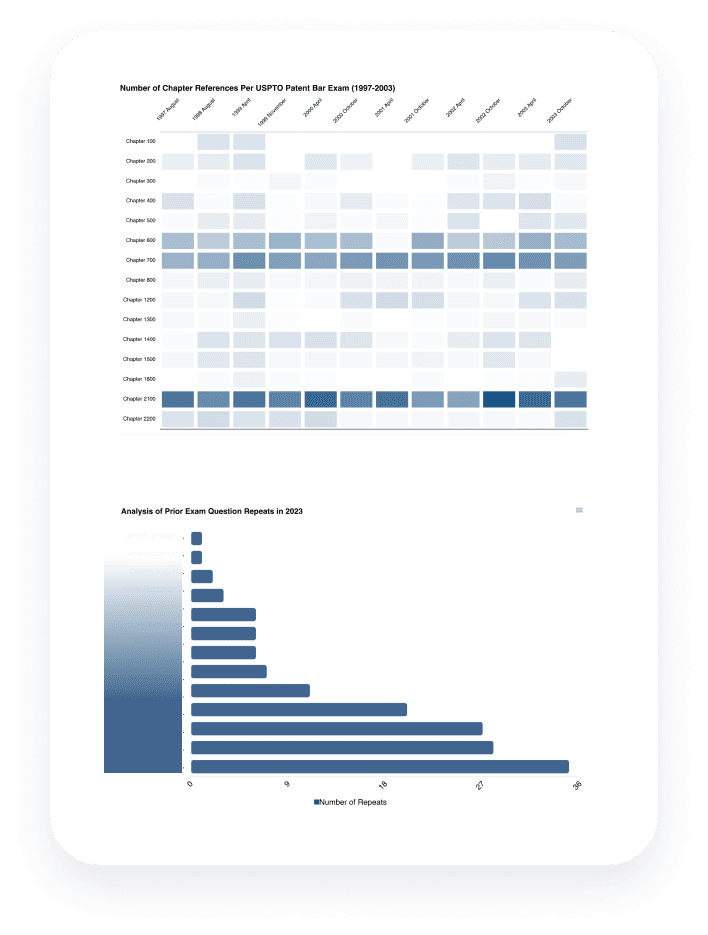
The MPEP contains thousands of pages covering every aspect of patent examination procedure. The patent bar exam, however, focuses on specific sections that appear repeatedly. Our course provides structured lessons covering all testable MPEP content, organized by frequency of appearance on actual exams.
High-Frequency Topics: These sections appear on virtually every exam and typically account for 60-70% of all questions. We provide extensive coverage with multiple examples, practice questions, and scenario-based applications. You’ll master patent applications, examination procedures, prosecution, and appeals until you can handle these questions in your sleep.
Medium-Frequency Topics: These sections appear regularly but less predictably. Our lessons highlight the specific subsections most likely to appear, saving you from memorizing rarely-tested material. We cover inventorship, secrecy orders, accessibility issues, restriction practice, reissue, and reexamination with targeted precision.
Lower-Frequency Topics: While these sections appear less frequently, they still account for 10-20% of exam questions. Our streamlined coverage ensures you’re prepared without over-investing time. We efficiently address parts practice, assignment, patent terms, design patents, plant patents, and international applications.
Each lesson includes clear explanations, practical examples, and connections to related MPEP sections. You’ll understand not just what the rules say, but how they apply to real patent prosecution scenarios that appear on the exam.
Over 1,000 Practice Questions Designed to Match Exam Difficulty
Reading about patent law is one thing. Answering 100 multiple-choice questions in six hours is quite another. Our practice questions bridge this gap by simulating actual exam conditions and difficulty levels.
Question Bank Structure: Our 1,000+ practice questions mirror the patent bar exam’s format, difficulty, and subject distribution. You’ll encounter the same question styles, answer choice patterns, and subtle distinctions that appear on the real exam. Many students report that our practice questions felt harder than the actual exam—exactly what you want during preparation.
Detailed Explanations for Every Answer: When you answer a practice question, you receive comprehensive explanations for why each answer choice is correct or incorrect. These explanations cite specific MPEP sections and include strategy tips for similar questions. You’re not just memorizing answers—you’re learning the underlying principles that let you handle variations.
Performance Tracking and Analytics: Our platform tracks your performance across all MPEP chapters, question types, and difficulty levels. You’ll see exactly which areas need more attention and which you’ve mastered. This data-driven approach eliminates guesswork from your preparation.
Timed Practice Exams: We provide multiple full-length practice exams that replicate the actual testing experience. You’ll practice managing time pressure, handling fatigue, and maintaining accuracy over 100 questions. Students who complete at least three full-length practice exams consistently report feeling calm and prepared on test day.
Customizable Question Sets: Create practice sets focused on specific MPEP chapters, difficulty levels, or question types. This flexibility lets you reinforce weak areas while maintaining strength in sections you’ve already mastered.
Personalized Study Plans That Adapt to Your Schedule
You have a unique background, available study time, and target exam date. Cookie-cutter study plans don’t work. That’s why we help you create a patent bar study plan tailored to your specific situation.
Flexible Time Frames: Whether you have six weeks or six months, we structure your preparation to use available time efficiently. Six-week intensive plans focus on high-yield topics and extensive practice. Longer timeframes allow for comprehensive coverage with more reinforcement. Both approaches work—the key is matching the plan to your schedule.
Milestone Check-Ins: Regular assessments measure your readiness and adjust your plan accordingly. You’ll know exactly where you stand at each stage and what to focus on next. This removes the anxiety of wondering whether you’re on track.
MPEP Navigation Skills That Save Time on Exam Day
The patent bar is an open-book exam. You can search the MPEP during the test. This sounds easier than it is. Poor navigation skills cost precious minutes and lead to wrong answers when you can’t find the right section quickly.
Strategic Search Training: We teach you exactly how to search the MPEP efficiently using the exam’s PDF interface. You’ll learn which keywords work, how to narrow searches effectively, and when to use the table of contents versus text search. These skills transform the MPEP from an overwhelming reference into a precision tool.
Section Recognition: Even better than searching is recognizing questions that reference specific MPEP sections you’ve studied. Our training helps you identify these connections instantly, letting you confirm answers in seconds rather than minutes. This recognition skill separates candidates who finish comfortably from those who scramble through the final questions.
Time Management Strategies: You have roughly 3.6 minutes per question. We train you to allocate this time wisely—when to search, when to rely on memory, and when to flag and return to difficult questions. Our timed practice exams build these instincts until they become automatic.
Expert Support When You Need It Most
Studying for the patent bar can feel isolating. Questions arise. Confusion develops. Motivation wavers. Our support system ensures you’re never stuck or alone in your preparation.
Community Forums: Connect with fellow students preparing for the same exam. Share study tips, discuss challenging questions, and celebrate milestones together. Many students form study groups through our forums, creating accountability and motivation.
Up-to-Date Content That Reflects Current USPTO Rules
The USPTO regularly updates the MPEP and examination procedures. Using outdated materials can lead you to study obsolete rules that have been superseded. We continuously monitor USPTO updates and immediately incorporate relevant changes into our course materials.
Regular Content Reviews: Our team reviews all MPEP revisions, Federal Circuit decisions, and USPTO policy changes. When updates affect testable material, we revise lessons and practice questions accordingly. You can trust that you’re studying current rules that will actually appear on your exam.
Revision Notifications: When we update content, enrolled students receive notifications highlighting what changed and why. This keeps you informed without requiring you to re-study material unnecessarily.
Recent Exam Trends: We track trends in recent patent bar exams, noting shifts in emphasis or new question styles. This intelligence informs our teaching priorities and practice question development, ensuring you’re prepared for the exam you’ll actually take, not last year’s version.
Who Should Take This Course
Wysebridge Patent Bar Review is designed for anyone serious about passing the USPTO registration exam and launching or advancing their career in patent law. Our students come from diverse backgrounds but share a commitment to thorough preparation.
Engineers and Scientists Pursuing a Patent Agent Career
If you have the technical background required for USPTO patent bar eligibility and want to transition into patent law, this course provides everything you need. You don’t need legal training to succeed—our course teaches you how to think like a patent professional and apply USPTO rules effectively.
Many engineers and scientists choose the patent agent career path for its combination of technical depth and legal practice. Patent agents draft patent applications, prosecute them before the USPTO, and provide valuable technical expertise to inventors and attorneys. The work is intellectually challenging, financially rewarding, and offers excellent work-life balance compared to other legal careers.
Our course is specifically designed for candidates without legal backgrounds. We explain concepts clearly, provide context for legal terminology, and show you how everything connects to patent prosecution practice. You’ll feel confident approaching the exam even if you’ve never taken a law course.
Law Students and Attorneys Building a Patent Law Practice
For law students and attorneys pursuing a patent attorney career, USPTO registration is essential. While you have legal training, the patent bar tests specific MPEP knowledge and USPTO procedures that differ significantly from general legal practice or even patent law coursework.
Our course efficiently targets the patent-specific knowledge you need without redundantly covering general legal principles you already know. We focus on USPTO-specific procedures, MPEP interpretation, and the practical skills necessary for patent prosecution.
Patent attorneys who pass the patent bar open doors to lucrative positions at specialized IP firms, in-house patent departments, and boutique prosecution practices. The combination of legal education and USPTO registration commands premium compensation and provides career flexibility that general practice attorneys rarely enjoy.
Career Changers Who Failed Previous Attempts
If you’ve taken the patent bar before without success, you’re not alone. The exam’s difficulty and the challenge of self-directed MPEP study trip up many qualified candidates. Wysebridge provides the structured approach and targeted practice that makes the difference on your next attempt.
Many of our most successful students came to us after failing with another prep course or self-study. They needed a different approach—one that focused on efficient learning, extensive practice, and building real exam-taking skills. Our course provides exactly that.
We understand the frustration and self-doubt that comes after a failed attempt. Our approach rebuilds confidence while addressing the specific knowledge gaps that led to previous unsuccessful outcomes. You’ll feel prepared and capable on exam day.
Busy Professionals Who Need Flexible Preparation
You’re working full-time, managing family responsibilities, or balancing multiple commitments. Traditional test prep programs expect you to dedicate 20-30 hours per week for months. That’s not realistic for most people.
Wysebridge works with your schedule, not against it. Our self-paced format lets you study during lunch breaks, evenings, or weekends. The comprehensive structure ensures you cover everything necessary even with limited daily study time. Our mobile-friendly platform means you can review flashcards during your commute, complete practice questions during a coffee break, or watch lesson videos in the evening.
We’ve seen professionals with demanding jobs pass the exam studying just 10-15 hours per week over 10-12 weeks. Consistency matters more than intensity. Our approach makes consistent progress achievable regardless of your schedule constraints.
How the Wysebridge Learning System Works
Passing the patent bar requires more than just reading the MPEP. You need to understand concepts deeply, recognize how they apply to exam questions, practice extensively, and develop time management skills. Our learning system guides you through each of these stages systematically.
Phase 1: Foundation Building (Weeks 1-3)
Your preparation begins with structured lessons covering high-frequency MPEP chapters. These lessons break complex procedures into understandable segments, provide context for why rules exist, and show you how they appear in exam questions.
During this phase, you’ll complete short quizzes after each lesson to reinforce key concepts immediately. This frequent testing strengthens retention and helps identify areas needing additional review before moving forward.
You’re also introduced to the MPEP navigation tools and search strategies. From day one, you’re practicing the skills you’ll use on exam day, building familiarity with the electronic format and search interface.
Phase 2: Knowledge Expansion (Weeks 4-6)
With high-frequency topics mastered, you expand to medium-frequency chapters while continuing to reinforce core concepts. The practice questions become more challenging, incorporating subtle distinctions and complex scenarios that separate basic comprehension from deep understanding.
You’ll complete your first full-length practice exam during this phase. This benchmark assessment reveals your current performance level and highlights specific areas needing additional attention. The experience of completing 100 questions under time pressure provides invaluable insight into your readiness.
Based on your practice exam results, your study plan adjusts to focus more time on weak areas while maintaining strength in sections you’ve mastered. This adaptive approach ensures efficient use of remaining study time.
Phase 3: Refinement and Practice (Weeks 7-8+)
The final preparation phase emphasizes extensive practice, simulated exams, and refinement of exam-taking strategies. You’ll complete multiple full-length practice exams, review every missed question thoroughly, and fine-tune your time management approach.
During this phase, you’re also reviewing lower-frequency MPEP chapters to ensure comprehensive coverage. While these topics appear less often, knowing them prevents the frustration of encountering questions you haven’t studied at all.
Your confidence builds as practice exam scores improve and time management becomes more comfortable. By exam day, you’ll have answered thousands of practice questions, completed multiple simulated exams, and proven your readiness through measurable performance improvement.
The Science Behind Our Teaching Methods
Wysebridge’s teaching approach incorporates proven learning science principles that maximize retention and understanding while minimizing wasted study time.
Spaced Repetition: Rather than cramming massive amounts of information at once, our system presents concepts repeatedly over expanding intervals. This spacing strengthens long-term retention and ensures you remember information months later on exam day, not just during initial study.
Active Recall Testing: Passive reading doesn’t build the retrieval strength necessary for exam success. Our frequent quizzes and practice questions require you to actively recall information, strengthening memory pathways and revealing gaps in understanding while there’s still time to address them.
Interleaved Practice: Rather than studying one topic until exhaustion before moving on, we mix topics strategically. This interleaving improves your ability to distinguish between similar concepts and choose correct answers when questions could plausibly apply multiple rules.
Deliberate Practice: Our practice questions target specific skills and provide immediate feedback with explanations. This deliberate practice approach, focused on challenging material with expert guidance, accelerates skill development far more effectively than simply answering questions without structured feedback.
Metacognitive Training: We teach you to monitor your own understanding, recognize when you’re genuinely prepared versus merely familiar with material, and adjust your study approach accordingly. These metacognitive skills improve learning efficiency and prevent false confidence that leads to exam failure.
Compare Your Options: Why Wysebridge Outperforms Alternatives
You have several options for patent bar preparation. Understanding their strengths and limitations helps you make an informed choice.
Self-Study with the MPEP
Some candidates attempt to study the MPEP independently without a structured course. While this approach costs nothing beyond registration fees, it comes with significant challenges.
The MPEP contains thousands of pages covering every aspect of patent examination. Self-study candidates waste enormous time on rarely-tested sections while potentially missing frequently-tested topics. Without practice questions and performance feedback, they lack reliable indicators of readiness.
Most importantly, self-study provides no guidance on exam strategy, time management, or MPEP navigation skills. These tactical elements often determine success as much as substantive knowledge.
Self-study works for a small percentage of candidates—typically those with extensive legal training or exceptional self-directed learning skills. For most people, the time wasted and increased failure risk makes this approach penny-wise but pound-foolish.
Free or Low-Cost Online Resources
Various websites offer free or inexpensive patent bar study materials, flashcards, and practice questions. These resources can supplement structured preparation but rarely provide sufficient preparation alone.
Free resources typically lack comprehensive coverage, organized curriculum structure, and expert guidance. Practice questions may not accurately reflect exam difficulty or current USPTO rules. There’s no way to verify accuracy or completeness.
Students using only free resources often fail to recognize gaps in their preparation until exam day. Without structured progression and readiness assessments, they lack confidence in their preparedness. Many end up purchasing a structured course after failing their first attempt—wasting both the exam fee and months of misdirected effort.
Competitor Patent Bar Courses
Several established companies offer patent bar prep courses. These courses provide structured content and practice questions, but important differences distinguish them from Wysebridge.
Content Focus: Some courses attempt comprehensive MPEP coverage, teaching rarely-tested sections in the same depth as high-frequency topics. This approach wastes study time on material unlikely to affect your score. Wysebridge focuses specifically on testable content weighted by appearance frequency.
Practice Question Quality: Not all practice questions accurately reflect exam difficulty and style. Some competitor questions are significantly easier than the actual exam, creating false confidence. Others test minutiae that never appears on real exams. Wysebridge’s questions match actual exam difficulty and subject distribution based on careful analysis of released exams and student feedback.
Price Differences: Some competitors charge $1,500-$3,000 for their courses. Wysebridge provides comparable or superior content at a fraction of this cost, making quality preparation accessible to more candidates.
Investment in Your Career: Course Pricing and Value
The Wysebridge Patent Bar Review Course represents a strategic investment in your career. Patent agents and attorneys earn significantly more than candidates with similar technical or legal backgrounds who aren’t USPTO-registered. The course pays for itself within weeks of career advancement.
Transparent Pricing with No Hidden Costs
We believe in straightforward, honest pricing. Our complete course, including all lessons, practice questions, personalized study plans, full-length practice exams, and expert support, is available as a one-time purchase with lifetime access.
There are no monthly subscription fees, no charges for practice exams, no premium tiers that lock away essential content. You get everything included, and you can access it indefinitely—even if you decide to take the exam months or years after enrolling.
Compare this to competitors charging $1,500-$3,000 for similar or less comprehensive courses. Wysebridge provides exceptional value without compromising quality. We keep costs reasonable because we want to make quality patent bar preparation accessible to everyone eligible to take the exam.
Return on Investment
Consider the financial impact of passing the patent bar:
Patent Agent Salary Increase: Engineers and scientists transitioning to patent agent positions typically see salary increases of $15,000-$30,000 annually compared to their previous technical roles. Within one year, this increase far exceeds the course cost.
Patent Attorney Career Advancement: Attorneys who pass the patent bar become eligible for positions at specialized IP firms and in-house patent departments that command $20,000-$50,000 higher salaries than comparable non-registered attorneys. The USPTO registration is often non-negotiable for these positions.
Avoiding Retake Costs: Each patent bar exam attempt costs $450 in registration fees. Failing costs not only this fee but also lost career advancement time and the emotional toll of repeated attempts. Investing in quality preparation that helps you pass the first time saves money and months of career delay.
Time Value: The difference between six weeks of efficient preparation and six months of unfocused self-study means five additional months earning at your post-exam salary level. For a patent agent earning $40,000 more than their previous position, this represents over $16,000 in opportunity cost—far exceeding any reasonable course price.
Getting Started: Your Path to Patent Bar Success
Beginning your patent bar preparation can feel overwhelming. Where do you start? How long will it take? What if you don’t have enough background? These concerns are natural, but Wysebridge makes getting started straightforward and confidence-building.
Verify Your Eligibility First
Before investing time in exam preparation, confirm that you meet USPTO patent bar eligibility requirements. The USPTO requires specific technical backgrounds for exam registration.
Most candidates qualify through one of these paths: (1) Bachelor’s degree in a recognized technical field such as engineering, computer science, physics, chemistry, or biology; (2) Bachelor’s degree in another field plus sufficient technical coursework; or (3) Passing the Fundamentals of Engineering exam.
If you’re uncertain about your eligibility, our detailed eligibility guide walks you through the requirements and helps you determine your qualification path. You can also contact us directly with questions about specific degree programs or coursework combinations.
Enrollment and Account Setup
Once you’ve confirmed eligibility, enrolling in Wysebridge takes minutes. Create your account, complete a brief questionnaire about your background and target exam date, and gain immediate access to all course materials.
Your personalized study plan generates automatically based on your questionnaire responses, but you can customize it further at any time. The platform walks you through getting started, including a tutorial on MPEP navigation tools and an orientation to practice question features.
Week One: Building Momentum
Your first week focuses on high-frequency MPEP Chapter 200 (patent applications) and getting comfortable with the learning platform. You’ll complete several lessons, answer your first practice questions, and begin developing MPEP search skills.
This initial week is intentionally structured to build confidence and establish study habits. The material is challenging but approachable, letting you see immediate progress. Many students report that first-week momentum carries them through the entire preparation period.
Ongoing Progress and Support
After the first week, you’ll settle into a sustainable study rhythm following your personalized plan. Regular progress assessments ensure you’re on track and adjust your plan if needed. Our support team remains available for questions, motivation, and guidance throughout your preparation.
You’ll complete your first full-length practice exam around week 4-6, depending on your study pace. This milestone provides tangible evidence of progress and helps you visualize exam day success.
Frequently Asked Questions
How long does it take to complete the course?
Most students complete the Wysebridge course in 6-12 weeks depending on their available study time and background. Candidates studying 15-20 hours per week typically finish in 6-8 weeks. Those with less time available prepare successfully over 10-12 weeks studying 8-12 hours weekly.
Your timeline depends on several factors: technical versus legal background (those with legal training may move faster through basic concepts), familiarity with the MPEP (candidates who’ve previously studied have a head start), and available study time (obviously, more hours per week means faster completion).
The course remains accessible indefinitely after enrollment, so you can take more time if needed without additional charges. Some students prefer longer preparation periods to thoroughly master the material and feel completely confident on exam day.
Do I need a legal background to use this course?
Absolutely not. Many of our most successful students are engineers and scientists with no prior legal training. The patent bar tests your ability to apply USPTO rules and navigate the MPEP—skills that can be learned through structured preparation regardless of your educational background.
Our course is specifically designed to work for candidates without legal backgrounds. We explain legal terminology clearly, provide context for why rules exist, and show you how everything connects to practical patent prosecution scenarios. You’ll receive the same quality preparation whether you’re an engineer, a scientist, or an attorney.
In fact, technical professionals often have advantages on the patent bar. Your attention to detail, systematic thinking, and comfort with complex technical material serve you well when learning USPTO procedures.
What if I’ve already tried other prep courses or failed the exam before?
Many of our most successful students came to Wysebridge after struggling with other approaches. If you’ve failed the exam previously or feel your current preparation isn’t working, our course provides the focused approach and extensive practice that makes the difference on your next attempt.
We specifically designed Wysebridge to address common weaknesses in other prep approaches: insufficient practice questions, inadequate exam strategy training, poor MPEP navigation instruction, and generic study plans that don’t adapt to individual needs. Students frequently tell us that Wysebridge clarified concepts that other courses left confusing.
If you’re coming from a failed attempt, our diagnostic assessments identify specific knowledge gaps that contributed to your previous result. Your personalized study plan addresses these weaknesses while building on areas you’ve already mastered. You won’t waste time re-learning material you already know well.
How do practice questions compare to the actual exam?
Wysebridge practice questions are carefully designed to match actual exam difficulty, question style, and subject distribution. Many students report that our practice questions feel slightly harder than the real exam—exactly what you want during preparation. If you’re performing well on Wysebridge practice exams, you should feel confident approaching the actual patent bar.
We continuously update our question bank based on student feedback from recent exams and careful analysis of publicly available USPTO materials. This ensures our questions reflect current exam trends and prepare you for the test you’ll actually take.
Each practice question includes detailed explanations citing specific MPEP sections. These explanations teach you not just what the right answer is, but why it’s correct and how to recognize similar questions. This approach builds deep understanding that transfers to exam day.
Is the course updated when the USPTO revises the MPEP?
Yes. We continuously monitor USPTO updates and immediately revise course content when changes affect testable material. The MPEP is updated periodically, and while most revisions are minor, some do impact exam content.
Enrolled students receive notifications when we update content, highlighting what changed and why. This ensures you’re always studying current rules without wasting time on outdated information.
Our team includes registered patent attorneys who practice before the USPTO daily. We catch relevant changes quickly and understand which updates matter for exam preparation versus routine clarifications that don’t affect testable content.
Can I access the course on mobile devices?
Absolutely. The Wysebridge platform works seamlessly on smartphones and tablets as well as desktop computers. You can watch lesson videos during your commute, complete practice questions during lunch breaks, or review flashcards while waiting in line.
This mobile accessibility helps busy professionals fit preparation into their schedules. Rather than requiring dedicated study blocks at a desk, you can make progress during small pockets of available time throughout your day. Many students report that mobile access was crucial to their ability to maintain consistent study habits.
Full-length practice exams are best completed on a computer to simulate actual exam conditions, but all content is accessible from any device.
What technical requirements are needed for the course?
Wysebridge works on any modern web browser with a stable internet connection. You don’t need to download special software or have particularly powerful hardware. If you can watch YouTube videos and browse websites normally, you can access our course without issues.
For the best experience, we recommend using an updated version of Chrome, Firefox, Safari, or Edge. The platform automatically adjusts to your screen size and connection speed, providing smooth performance on everything from smartphones to desktop computers.
How does the money-back guarantee work?
Our money-back guarantee is straightforward: If you complete the full Wysebridge course, including all lessons and practice exams, take the patent bar exam, and don’t pass, we’ll refund your course fee completely.
We’re confident in our course’s effectiveness, and this guarantee demonstrates that confidence. You risk nothing by choosing Wysebridge—either you pass and advance your career, or you get your money back.
What happens after I pass the exam?
Congratulations! After passing, you’ll complete the USPTO registration process to receive your official registration number. This typically takes a few weeks after your exam result is released.
Your Wysebridge access remains active indefinitely even after passing. Many students return to reference materials during their early career, and you’re always welcome to use the course as a refresher resource.
We also provide career guidance resources to help you leverage your new USPTO registration. Whether you’re pursuing a patent agent position, building a patent attorney practice, or transitioning from another field, we offer advice on job searching, resume writing, and interview preparation.
How is Wysebridge different from just reading the MPEP?
The MPEP is a comprehensive reference manual covering every aspect of patent examination, totaling thousands of pages. While it’s technically possible to read the entire MPEP and prepare for the exam, this approach has significant problems.
First, the MPEP doesn’t distinguish between frequently-tested topics and rarely-covered material. Self-study candidates waste enormous time on sections that may appear in one question every few years while potentially missing high-frequency topics that appear on every exam.
Second, reading about rules differs fundamentally from applying them under timed exam conditions. Without extensive practice questions and simulated exams, you don’t develop the recognition skills and time management abilities necessary for exam success.
Third, the MPEP doesn’t teach you how to navigate itself efficiently during the exam. Wysebridge provides strategic training on MPEP searches, section recognition, and time allocation that self-study candidates typically lack.
Finally, self-study provides no feedback on your readiness. Without practice exams and performance tracking, you won’t know whether you’re truly prepared or just familiar with the material. Many self-study candidates feel ready but fail because they overestimate their mastery.
Wysebridge transforms the MPEP from an overwhelming reference into a navigable tool while providing the practice, strategy training, and readiness feedback necessary for exam success.
Can I study with other people using the course?
While each enrollment is for individual use, we encourage students to form study groups and connect with fellow Wysebridge students through our community forums. Many students find that discussing challenging concepts with peers enhances understanding and provides motivation.
If you’re part of a firm or organization preparing multiple candidates simultaneously, we offer group licensing options that provide cost savings while facilitating collaborative preparation. Contact us to discuss group arrangements.
What if I need to postpone my exam date?
Life happens. If you need to postpone your target exam date, simply adjust your study plan timeline in your account dashboard. The system will automatically redistribute remaining material across your new timeframe.
Since your Wysebridge access is lifetime, there’s no pressure to complete the course within a specific period. Take the exam when you’re truly ready, not when an arbitrary deadline demands it.
Understanding the Patent Bar Exam Itself
Success on the patent bar exam requires understanding not just the MPEP content but also the exam format, logistics, and strategy. Here’s what you need to know about the test itself.
Exam Format and Structure
The patent bar consists of 100 multiple-choice questions divided into two sessions of 50 questions each. You have three hours per session, giving you roughly 3.6 minutes per question. The exam is computer-based and includes access to a searchable PDF of the MPEP.
Questions typically present a scenario followed by four answer choices. You must select the single best answer. Some questions ask what action is proper, while others ask what action is improper. Reading carefully to understand what the question asks is crucial.
Questions are drawn from all areas of the MPEP, with heavy emphasis on patent applications, examination procedures, prosecution, and appeals. The distribution isn’t fixed—your exam might emphasize different chapters than another candidate’s exam.
The exam is open-book in that you can search the MPEP, but time pressure means you can’t read extensively during the test. Efficient navigation skills and strong foundational knowledge are essential.
Scoring and Passing Standards
The patent bar uses a scaled scoring system. You need a scaled score of 70 to pass, which typically corresponds to answering approximately 63 of 90 scored questions.
Not all questions count toward your score. The USPTO includes experimental questions that are being evaluated for future exams. You won’t know which questions are experimental, so treat every question seriously.
There’s no penalty for guessing. If you’re unsure of an answer, eliminate obviously wrong choices and make your best guess. Never leave questions blank.
Registration and Scheduling
You register for the patent bar through the Prometric testing system after applying with the USPTO and receiving approval. Exam availability varies by location but is generally offered year-round at Prometric testing centers nationwide.
The registration fee is $450. This fee is non-refundable if you fail and need to retake the exam, providing strong motivation to prepare thoroughly the first time.
Plan to take the exam when you’re genuinely ready, not when a convenient testing date appears. An extra week or two of preparation is worth far more than rushing to meet an arbitrary schedule.
What to Expect on Test Day
Arrive at the testing center early to complete check-in procedures. You’ll provide identification, be photographed, and store personal belongings in a locker. The testing center provides scratch paper and pencils for notes during the exam.
The testing environment is quiet but not completely silent—you may hear other test-takers typing or moving. If noise bothers you, the center provides earplugs.
You can take a break between the two sessions but not during sessions. Use the break to clear your head, stretch, and prepare mentally for the second half.
Results are typically available within a few days to two weeks after your exam. You’ll receive an email with a pass/fail notification and your scaled score.
Take the Next Step Toward Your Patent Career
The patent bar stands between you and the career opportunities you’re working toward. Whether you’re pursuing a patent agent position, building a patent attorney practice, or expanding your career options with USPTO registration, passing this exam opens doors.
Wysebridge Patent Bar Review gives you everything needed to pass: comprehensive MPEP coverage focused on testable material, over 2,000 practice questions matching exam difficulty, personalized study plans adapting to your schedule and progress, expert support from registered patent attorneys, and proven teaching methods based on learning science.
We’ve helped hundreds of students pass the patent bar on their first attempt. Engineers with no legal background, attorneys expanding into patent law, and candidates who failed with other preparation methods have all succeeded with Wysebridge. You can too.
The difference between passing and failing isn’t intelligence or background—it’s preparation. The structured approach, extensive practice, and strategic guidance provided by Wysebridge transforms the overwhelming MPEP into navigable, testable knowledge. You’ll approach exam day confident, prepared, and ready to succeed.
Don’t let poor preparation or unfocused study cost you exam fees and career advancement time. Invest in proven preparation that works. Enroll in Wysebridge today and take the first step toward passing the patent bar and advancing your career.
Your future as a patent professional begins with passing the patent bar. Wysebridge is here to help you achieve that goal efficiently and confidently. Let’s get started.
get started
Pass the patent bar and become a leading patent practitioner today!

Continuous updates to content
We continue to refine and update our study materials and questions to ensure you are studying exactly what is needed to pass the patent bar exam.

Your personalized Patent Bar Review
Your platform enables you to study at your own pace with real-time data feedback, community support, and more.

Save up to 50% time and money

Expertise and Data Insights
Our patent bar review team has served more than 6000+ individuals pass the patent bar exam. We built Wysebridge.com to help you accelerate your patent and IP law career.