Wysebridge Research / Patent Bar / 2026 Buyer's Guide
Best Patent Bar Prep Courses in 2026: The Buyer's Shortlist
Choosing a patent bar prep program is about more than finding the largest course or the lowest price. You need accurate current-law instruction, realistic practice, efficient MPEP research and a study format you can sustain. Wysebridge is our top pick for candidates who prefer integrated, practice-centered preparation. PLI is a strong alternative for learners seeking lecture-oriented instruction, while Patent Education Series and PatBar deserve consideration for their different formats and prices. This buyer's guide explains the tradeoffs so you can choose deliberately.
Best for integrated practice: Wysebridge. Its 3,000+ questions, timed simulation, performance tools and MPEP-linked learning keep instruction and practice in one workflow. Confirm the specific features and access terms on the live plan before enrolling.
02
Best for lecture-oriented learners: PLI. A structured instructional approach may work better than predominantly independent question practice for someone who wants to be taught the underlying material at length. Verify the current format and available teaching support directly with PLI.
03
Best for mixed media: Patent Education Series. Its course page advertises 12 hours of video, 12.5 hours of audio summaries and 2,800+ questions. That combination may appeal to learners who prefer switching among formats.
04
Best for traditional home study: PatBar. Its website advertises a $495 program and a long history in the market. Assess whether its teaching format and tools match how you actually learn.
05
Free resources are useful, not automatically sufficient. The USPTO's governing materials are fundamental no matter which course you buy. The value of a paid program is structured explanation, focused practice, feedback and accountability, not exclusive ownership of the law.
Editor's shortlist: our top pick
Wysebridge, best for integrated patent bar preparation
Practice questions, MPEP tools, timed exam simulation and adaptive review in one study workflow. $189/month or $594 one payment.
What patent bar prep actually is (and what it is not)
Patent bar preparation is a structured way to study for the USPTO Registration Examination. The examination tests knowledge of the laws, regulations and procedures relevant to patent practice before the Office. It is not a general intellectual property survey, a patent drafting practicum or a substitute for checking whether you meet the USPTO's eligibility requirements. A candidate may have an advanced engineering degree and still need to learn unfamiliar procedural rules, deadlines, appeal procedures and prosecution workflow.
Successful preparation usually combines three kinds of work. First, candidates learn the framework: how prosecution proceeds, which rules govern specific situations and where the important material appears in the MPEP. Second, they practice applying those rules to exam-style questions, including deliberately misleading answer choices. Third, they develop a practical MPEP search strategy that works under time pressure. A searchable reference may be available during the examination, but finding the right authority still consumes valuable minutes.
A paid course can organize those activities through lessons, question banks, simulated testing, explanations, schedules and feedback. Different programs make different tradeoffs. Some emphasize comprehensive video teaching. Others favor active problem-solving, printed workbooks, self-guided reading or individualized instruction. No single format is ideal for every candidate.
The best course for you is the one whose content is current, whose evidence is credible and whose daily study workflow you will actually use. This guide compares available paths rather than assuming a higher price or a larger question count automatically yields a higher pass probability.
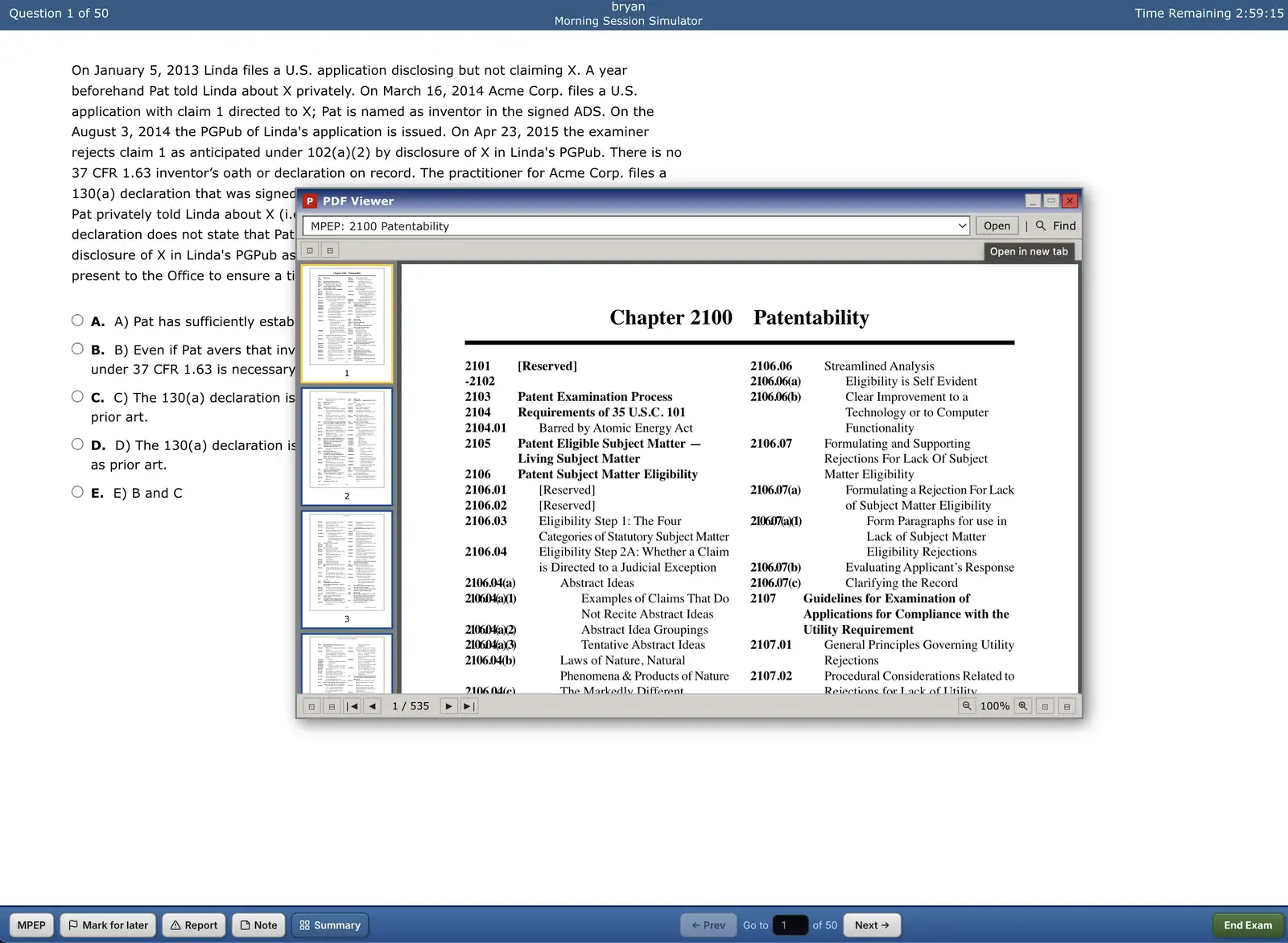
MPEP lookup inside a timed simulator session, captured from the live product.
See what practice looks like inside Wysebridge
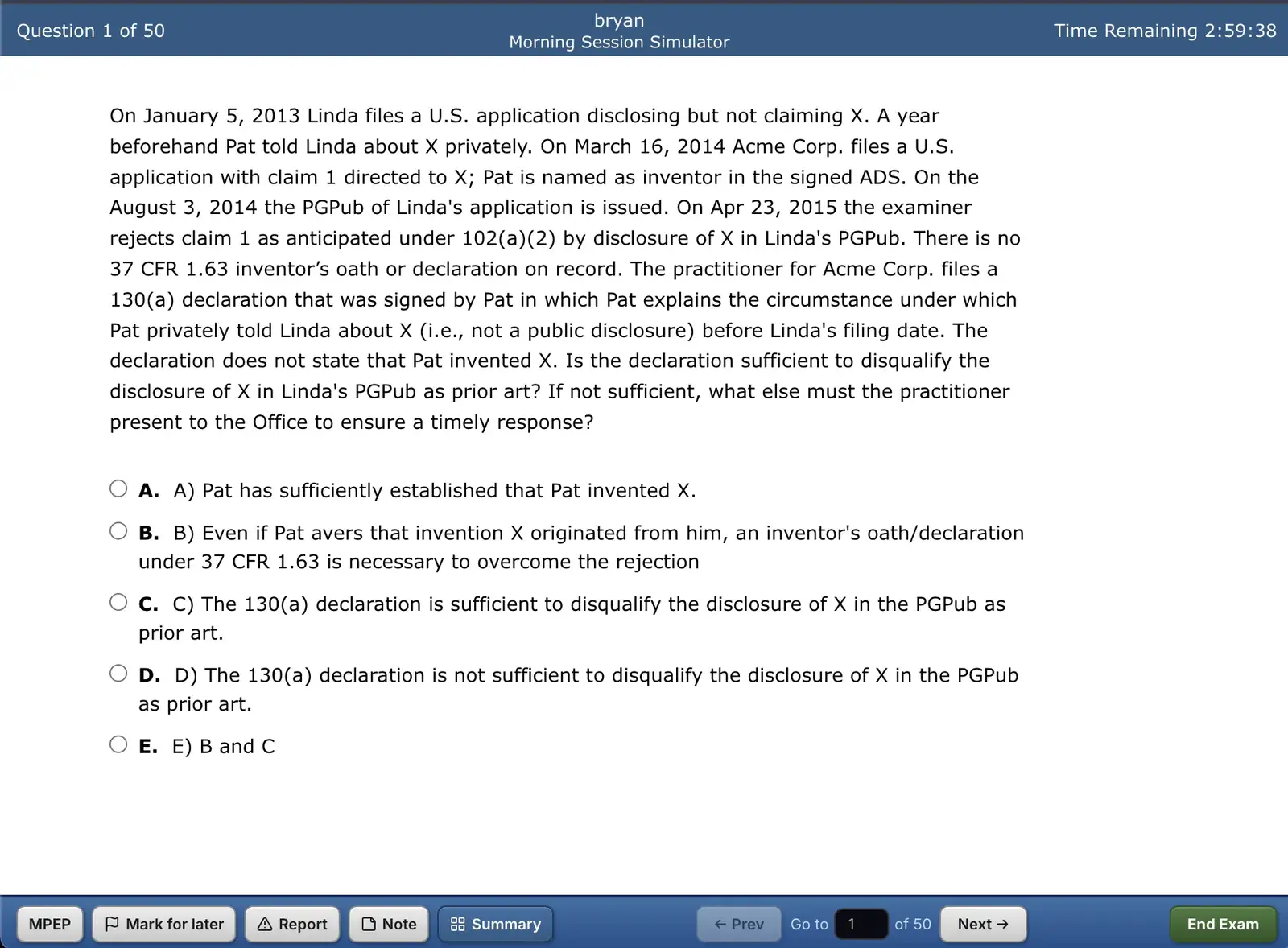
A timed question with the MPEP open beside it, the way you will search it on exam day.
Ranking scope: courses marketed to U.S. patent bar candidates and the free USPTO self-study alternative. We review each criterion against public, dated sources and do not turn missing information into a negative score. These are editorial best-fit selections, not an independently measured prediction of pass probability.
Scroll the table sideways to see every column.
Evaluation criteria and weights for patent bar prep programs
Criterion
Weight
What we verify
Content currency and accuracy
25%
Current USPTO source-material alignment, citations, correction policy
Question practice and explanations
20%
Verifiable count and quality, explanation depth, useful remediation
Method: we rate verified features against this rubric with written justifications. We will publish weighted numeric scores only after every provider has been reviewed against the same rubric from the same kind of evidence; until then, the rankings below are qualitative recommendations. Publisher-reported pass rates, including ours, are not interchangeable with independent comparative data. Official USPTO material is linked throughout, and every competitor check is dated.
The Best Patent Bar Prep Courses in 2026
A course should fit the candidate, not the other way around. Our shortlist emphasizes the learning experience: what the student actually does each week, what happens after a wrong answer and how the platform prepares a candidate for the real test environment. Below, we discuss where each option stands out, and the important limitations to consider before making a purchase.
1. Wysebridge: Best for Integrated, Practice-Centered Patent Bar Prep
Wysebridge Patent Bar simulator, captured from the live product.
$189/month or $594 one payment · from the live catalog5-day free trial on One-Pay; a card is required at checkout and you are billed on day 5.
Bundle
Wysebridge ONE $697: Patent Bar for 12 months plus IP courses and practitioner tools
Questions
3,000+, including all 18 released USPTO exam administrations (1999–2003) Verified
Company
Founded 2012; 6,000+ learners served Publisher-reported
Wysebridge is built around the idea that preparation improves when learning, practice and reference research happen together. Students work through MPEP-focused material, answer exam-style questions, review explanations and practice timed sessions without building an entirely separate study system. The question bank combines every question the USPTO released from its 1999–2003 administrations with USPTO-derived questions and Wysebridge-authored questions on post-AIA law.
Its strongest differentiator is not simply the number of questions. It is the way an incorrect answer can lead a learner back to the governing rule and another targeted practice opportunity. The integrated MPEP tools and performance feedback are particularly appealing to candidates who learn by doing. The exam simulator is Prometric-style: a useful rehearsal of timing, navigation and MPEP lookup, not a certified replica of the live exam.
Wysebridge also offers a broader route through Wysebridge ONE, connecting exam preparation with IP law courses and practitioner resources. That is valuable to someone planning a longer career in patent practice; the plan page lists exactly what each plan includes and for how long.
What stands out
One connected workflow, timed question practice, MPEP learning, a clear one-time price option and a broader professional education pathway.
What to weigh
This is not a lecture-first product; students wanting extensive chapter-by-chapter videos should examine lecture-oriented alternatives. Our outcome figures are self-reported, so judge the product by the trial rather than by our numbers.
Best suited for: Engineers, scientists and working professionals who want to prepare through repeated practice and feedback rather than watching long recorded lectures. Also a good fit for candidates interested in moving into applied IP education after the exam.
Not confirmed · confirm the current offer with the provider
Guarantee
Continued course access until you pass, at no added charge, per PLI's course page Publisher-reported
Practising Law Institute is one of the most widely recognized names in U.S. legal professional education, and its patent bar program is frequently considered by candidates who want a more formal course experience. The principal reason to evaluate PLI is instructional style. Candidates who want a teacher to explain concepts in sequence, rather than beginning primarily with self-directed question practice, may find a comprehensive teaching program reassuring.
For a candidate entering patent law from engineering or scientific research, a well-organized lecture sequence can provide context before drilling individual procedural exceptions. That structure can also reduce the burden of creating a study plan from scratch. The tradeoff is that lecture-based preparation takes time, and watching material is not itself proof that a candidate can locate and apply the correct MPEP rule during a timed exam.
Before purchasing, compare what is included in the currently sold PLI package: access duration, lectures, practice questions, MPEP materials, update policy, support and any retake provisions. PLI's price varies by offer and possible eligibility for discounts, so we have not republished a figure: a price read from PLI's own checkout on the day you buy is the one to trust, not a number recycled from comparison blogs.
What stands out
Formal teaching reputation and an established instructional approach.
What to weigh
Price, study time and how much active MPEP practice you will do beyond attending or watching lectures.
Best suited for: Candidates who learn best by following a comprehensive instructor-led curriculum. Especially worth comparing if an employer or law school covers the cost.
3. Patent Education Series: Best for Multiple Learning Formats
$597 standard, 12-month online plan · checked October 2026; confirm at checkoutA lower promotional price was displayed during research and may have expired; check the current checkout.
Advertised
2,800+ questions, 12 hours of video instruction, 12.5 hours of MPEP audio summaries Publisher-reported
Refund
14-day money-back guarantee on 12-month plans (3-day on 30-day plans); conditions apply Publisher-reported
Patent Education Series stands out as a mixed-format learning option. Its current overview describes a course that develops procedural understanding through instruction, summaries and practice questions, with an emphasis on gradually becoming exam ready. Candidates who find it difficult to learn exclusively from text or question banks may appreciate having video, audio and written explanations available in one program.
The provider also discloses a relatively detailed feature inventory: quizzes, glossaries, chapter materials, question decks, MPEP search instruction and an exam engine. That matters because an advertised question count can aggregate different types of exercises; a buyer should ask how many full exam-style questions are provided and how answer explanations are delivered.
A twelve-month access term may be useful to candidates with uncertain examination dates, while a thirty-day plan can suit someone already well prepared. Compare the actual costs of shorter and longer commitments, as well as the provider's extension rules. Prospective students should confirm current discounts directly on its site rather than assuming a limited-time code remains valid.
What stands out
A clearly described blend of video, audio, printed materials and question-based study.
What to weigh
Whether the mix fits your learning style, what its question categories mean and whether a promotional price is still valid.
Best suited for: Learners who want to move between listening, watching, reading and practicing. Also worth considering for candidates who value a clearly defined access period and optional print materials.
$495 advertised · checked October 2026; confirm at checkout
History
Origins dating to 1992, per its website Publisher-reported
Guarantees
30-day refund for any reason; another 9 months of access if you don't pass; refund if the USPTO finds you don't qualify Publisher-reported
PatBar markets itself as a long-established patent bar review provider, with origins dating to 1992. Its website emphasizes the familiar fundamentals of a home-study program: studying examination subjects, understanding the legal materials and learning how to find relevant answers. For some candidates, that relatively direct approach is preferable to a platform with numerous modern learning interfaces and dashboards.
At an advertised $495, PatBar can be appealing to buyers balancing cost and course structure. But price should not be the only metric. Compare its current practice format, available explanations, length of access, help with unfamiliar legal concepts, simulator details and frequency of updates against the USPTO's currently tested materials. A traditional program is not inherently less effective than a newer digital platform, just as a modern platform is not automatically better.
The most important question is what kind of learner you are. If you work well independently, prefer established study material and do not need a large number of interactive tools, a more conventional offering may be enough. If immediate feedback, fine-grained progress analytics or integrated practice are central to your workflow, compare those features directly before deciding.
What stands out
Long-standing market presence and a clearly advertised base price.
What to weigh
Verify exact current access, teaching format, source-material updates and digital practice tools.
Best suited for: Self-directed candidates who want a familiar home-study format at a comparatively accessible price. Buyers should try to inspect the materials before committing if detailed digital tools are important to them.
5. USPTO Official Materials: Best for Free Self-Study
Free reference materials · checked October 2026; confirm at checkoutExam and Prometric fees are separate.
Status
The governing source for registration rules and tested materials Official source
The USPTO is the primary source for registration rules, subject-matter references and candidate information. Every student, whether paying for a course or studying independently, should be comfortable finding the currently designated exam materials and understanding the Office's instructions. Official documents are particularly valuable because third-party courses are educational intermediaries, not the authority for what is tested.
Free self-study can be effective for disciplined candidates who can design their own syllabus, identify weak topics and repeatedly practice applying the rules. The apparent savings are substantial: the governing materials themselves are available without buying a commercial course. The tradeoff is the work of deciding what to study when, connecting released examination-style questions to current law, and arranging timed practice without a dedicated tool.
A sensible hybrid approach is to begin with official information, use free exercises and then decide whether personalized feedback, a question bank or a simulator would save enough time to justify a paid program. No course should discourage direct use of official source material. Always check current registration eligibility, tested source documents and fees with the USPTO itself.
What stands out
Authoritative and freely accessible source materials.
What to weigh
Requires substantial independent planning and may not provide a guided feedback loop.
Best suited for: Experienced self-learners with time and strong research discipline. Also essential supplemental reading for every paid-course student.
Additional options we investigated: OmniPrep. OmniPrep appears in longstanding comparisons of patent bar preparation, with older materials describing guided plans, MPEP summaries, simulation and subject-matter help. Different sites currently associated with the OmniPrep name show inconsistent offers, and one includes unrelated placeholder text in its plan descriptions. That says nothing about the quality of any purchased content, but we could not confirm the active product, canonical site or purchase terms, so it is not ranked. If you consider it, confirm ownership, checkout, current materials, access length and support directly; do not rely on third-party price tables. Sources: omnipreppatent.com and omniprep.org, checked October 2026.
Side-by-Side Comparison
Prices and features refer to each provider's public description; discounts, details and access periods change. Verify each seller's checkout and materials before purchasing. Not confirmed means our research has not established the feature, not that it is absent.
Scroll the table sideways to see every column.
Patent bar prep options compared by advertised price, learning style, question practice, simulator, MPEP integration, post-pass education and guarantee
Option
Advertised price
Learning style
Question practice
Timed simulator
MPEP integration
Post-pass education
If you don't pass
Wysebridge Patent Bar
$189/month or $594 one payment
Practice-centered
3,000+ (production count)
Prometric-style, timed AM/PM sessions
MPEP viewer in the simulator; explanations cite sections
IP courses and practitioner tools in Wysebridge ONE
Access until you pass, extended a year at a time (One-Pay)
PLI
Not confirmed
Lecture / structured
Not confirmed
Not confirmed
Not confirmed
Wider PLI legal catalog
Continued course access until you pass, at no added charge
Patent Education Series
$597 standard, 12-month online plan
Video, audio, text and practice
2,800+ advertised
Exam engine advertised
MPEP search instruction advertised
Not confirmed
6-month access extension if you don't pass (12-month plans; conditions apply)
PatBar
$495 advertised
Home study
Not confirmed
Not confirmed
Not confirmed
Not confirmed
Another 9 months of access free if you don't pass
USPTO official materials
Free
Self-study
Officially released past exams
No dedicated course tool
The official source
Official practitioner guidance
Not applicable
Competitor facts read from each provider's site, October 2026; Wysebridge prices from the live catalog. Competitor refund and guarantee terms as published on each provider's website, as of October 2026. "Not published" means we could not find a stated policy. Terms change; check the provider's current terms before buying.
Which Patent Bar Prep Program Fits Your Use Case?
Scroll the table sideways to see every column.
Patent bar candidate profiles matched to a starting option
Candidate
What they need
Best starting option
Why
Engineer or scientist with a full-time job
Focused, repeatable study sessions
Wysebridge
Practice and progress feedback in one system
Learner who needs comprehensive lectures
Instructor-sequenced explanation
PLI
Formal teaching orientation
Learner who studies during commutes
Audio and multiple media formats
Patent Education Series
Advertised video and audio materials
Budget-focused independent learner
Lower initial course expense
PatBar or free USPTO resources
Price and self-study tradeoffs
Retaker who knows weak chapters
Targeted remediation and simulation
Wysebridge
Chapter-oriented practice and timed drills
Unsure whether to purchase
Low-risk exploration
Free USPTO resources plus course trials
Confirm fit before paying
What Results Look Like: From Studying Rules to Applying Them
Outcome claims are only as good as their method, so we show how practice works inside the product first, and the student evidence second, labeled for what it is.
1
See a practice question and identify the governing subject.
Every question is tied to the MPEP section it tests.
2
Read the explanation and inspect its cited MPEP section.
A wrong answer becomes a lookup, not just a correction.
3
Repeat a topic drill and inspect your progress by chapter.
Weak chapters surface from your own answer history.
4
Simulate a timed session and review mistakes after completion.
Prometric-style AM and PM sessions, with no in-session feedback.
I passed on my first attempt using only Wysebridge for study materials. I had a limited amount of time to study for the exam, so I needed to make the most of it. What really stands out to me about the Wysebridge system is how efficient it is. The Patent Bar is equal parts skill and knowledge — and Wysebridge delivers both.
Michael Pistorio, Patent Attorney Public Google review of Wysebridge; outcome self-reported by the reviewer.
I passed the patent bar exam in my first attempt. Wysebridge was the only review that I was relying on and I am really thankful to the Wysebridge team for putting together all the study material in an extremely systematic fashion. The practice questions were very comprehensively covered and the practice test really simulated the actual exam. Overall highly recommended and totally worth every penny.
Yogini Bhavsar-Jo, Patent Agent Public Google review of Wysebridge; outcome self-reported by the reviewer.
Why there is no pass-rate headline here. Wysebridge tracks self-reported student outcomes, but until we publish the cohort size, response rate and how non-responders are counted, we do not think a single percentage belongs in a buyer's guide. The current figures and their limits are on our pass rates page; ask any provider, including us, the same questions.
Frequently Asked Questions
How do I choose the best patent bar review course?
Choose based on current-law coverage, question explanations, MPEP search practice, study format, price and refund or access terms. Try an actual lesson or sample exam before buying when possible.
What is the difference between patent bar review and intellectual property law courses?
Patent bar review targets the USPTO Registration Examination and its tested procedures. General IP law courses cover a wider field, including trademarks, copyright and trade secrets, and do not replace exam-specific preparation.
How many patent bar practice questions do I need?
There is no universally established minimum that guarantees passing. Prioritize understanding, useful explanations, realistic timing and the ability to revisit weaker concepts over raw question volume.
What is the MPEP, and why should I practice searching it?
The Manual of Patent Examining Procedure explains USPTO practice and is central to patent bar preparation. Finding relevant rules quickly can make a major practical difference during timed questions.
How long does patent bar preparation take?
Preparation varies with prior legal exposure, study hours and individual progress. Start with a diagnostic assessment and build a realistic schedule around your exam date rather than treating any one timeline as guaranteed.
What if I prefer video lectures?
Compare lecture-oriented providers such as PLI or Patent Education Series with practice-centered options. The right choice is the one you can consistently use while still doing timed questions and rule lookups.
What if I don't pass on my first attempt?
Confirm the provider's extension and refund terms in writing before purchasing. After an unsuccessful attempt, focus on diagnosing procedural misunderstandings and rebuilding targeted practice rather than simply rereading everything.
How do I prepare for patent practice after passing the exam?
The exam is an entry requirement, not a complete practice apprenticeship. Seek practical training in inventor interviews, prior-art searching, claim drafting, office-action responses and client communication.
Try Patent Bar Prep for Free, Before Choosing a Course
Build your patent bar study plan by seeing how an integrated, practice-based program feels before committing. Explore the actual Wysebridge tools, inspect the question explanations and decide whether the learning style suits you. Practice using the MPEP rather than only memorizing answers. Compare the standard Patent Bar plan with Wysebridge ONE if you also want to develop professional skills after the examination. The 5-day trial needs a card at checkout and bills on day 5 unless you cancel, so review the trial terms before enrolling.
Every comparative claim in this guide is traceable to a provider's own page, an official source or Wysebridge production data. Competitor pages were read in October 2026 and are re-read before each update; prices can change at any time, so confirm at checkout. Wysebridge figures come from the same catalog checkout charges from. Product screenshots are captures of the live Wysebridge product; we do not reproduce or simulate other providers' interfaces. Spot an error? Tell us and we will correct it.