Exam Overview
Patent Bar Exam Questions: Types, Examples, and Strategy
Patent Bar exam questions are multiple-choice questions built around USPTO patent practice and the source materials identified for the registration examination. Each question has five answer choices. The exam contains 100 questions total, but only 90 are scored; the other 10 are unscored beta questions.
The current examination is confidential, so no prep provider can publish a verified percentage breakdown of the exact question types appearing on today's test. What candidates can study are the recurring question patterns seen in released USPTO exams, the current tested rules, and the reasoning skills needed to work through five-choice fact patterns efficiently.
This page focuses on question structure and answering strategy. For timing, sessions, breaks, scoring, and reference access, see the Patent Bar exam format page.
- 100
- Total questions
- 90 scored, 10 unscored
- 5
- Answer choices
- Per question
- 63/90
- To pass
- Correct scored answers
- 3.6 min
- Per question
- Average in a 3-hour, 50-question session
Question structure
What Do Patent Bar Questions Look Like?
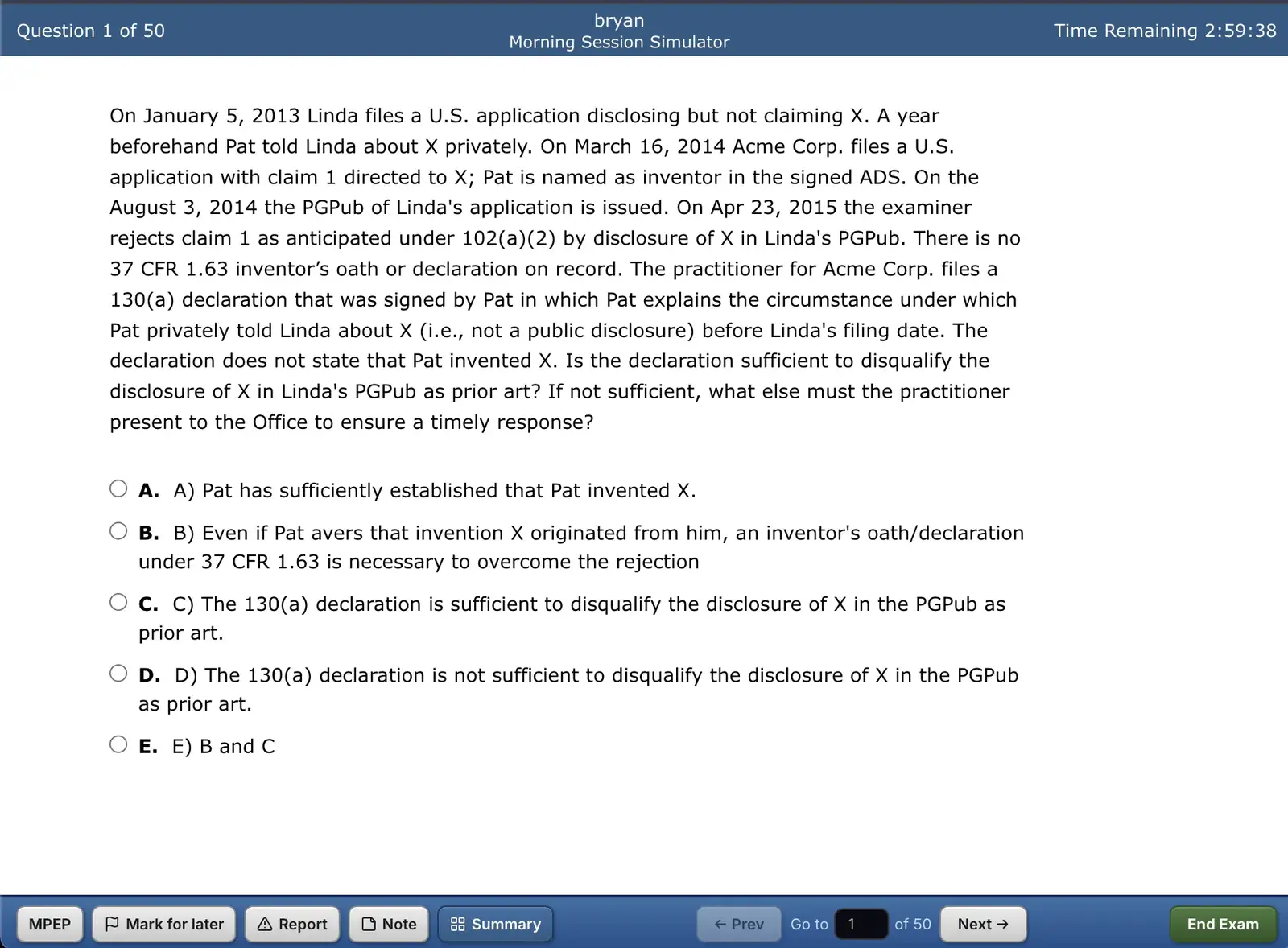
Most Patent Bar questions present a rule, procedural problem, or factual scenario and ask which answer is correct under USPTO practice. Some are relatively direct. Others require several steps: identify the controlling issue, determine which rule applies, notice an exception, and distinguish the best answer from several plausible choices.
The USPTO does not publish a current taxonomy of question types. The categories below are therefore useful study patterns, not an official or fixed percentage breakdown of the confidential examination.
Six patterns
Common Patent Bar Question Patterns
Direct Rule Questions
These questions test whether you know a specific USPTO rule, deadline, requirement, or procedural consequence. They may ask when a response is due, what must be included in a filing, whether an action is permitted, or which requirement applies to a particular procedure.
Best approach
Identify the governing rule first. If the rule is uncertain or has an exception, verify it in the current USPTO source material instead of relying on a vague memory.
Fact-Pattern Application Questions
These questions give you a sequence of events and ask you to apply the governing rules to those facts. Dates, filing relationships, claim status, applicant actions, or examiner actions may all matter.
Best approach
Separate legally meaningful facts from background detail. Build a quick timeline when dates matter, then identify the MPEP chapter or other source most likely to contain the controlling rule.
EXCEPT, NOT, and Incorrect-Statement Questions
These questions reverse the normal task: four answers may be correct and one is wrong, or four may be wrong and one is correct. The difficulty is often reading accuracy rather than obscure doctrine.
Best approach
Mark the negative word in the question stem before evaluating the choices. Then test each answer against the source instead of choosing the first statement that looks familiar.
Multi-Statement and Combination Questions
Some questions ask which of several numbered statements are correct or provide answer choices built from combinations of statements. These reward disciplined elimination because one clearly false statement can remove several answer choices at once.
Best approach
Evaluate the statements individually before looking at the combinations. This reduces the risk of being distracted by answer-choice formatting.
Claim, Prior-Art, and Eligibility Fact Patterns
Questions involving claims, prior art, effective filing dates, subject-matter eligibility, or obviousness can require careful statutory and procedural analysis. Older released questions may use pre-AIA rules, while current preparation must account for the law and source materials tested by the USPTO now.
Best approach
First determine whether the question is asking about current post-AIA treatment or a historical fact pattern governed by earlier law. Never assume a released 1997–2003 answer remains substantively correct today without verification.
PCT, Appeals, Reissue, Reexamination, and Other Procedure Questions
The exam can also test specialized procedures such as international applications, appeals, reissue, reexamination, representation, and post-grant matters when those subjects are included in the USPTO's current source materials.
Best approach
Know which source and chapter govern the procedure so you can narrow the search quickly when a question goes beyond the rules you have memorized.
Sources
Are Patent Bar Questions Based Only on the MPEP?
No. The MPEP is the central examination reference, but the USPTO currently lists additional source materials for registration-examination questions and answers. As of September 2026, the source list includes MPEP Ninth Edition, Revision 01.2024, plus the Consolidated Trial Practice Guide, representation-rule materials, and Global/IP5 Patent Prosecution Highway materials.
Candidates should therefore prepare from the current USPTO exam source materials, not from the assumption that every possible answer can be found in the MPEP alone. For chapter-level navigation, use the MPEP chapter guide.
Format
How Many Answer Choices Are There?
Each Patent Bar question has five answer choices. Ten of the 100 exam questions are unscored, but they are not identified during the test. Candidates should therefore treat every question as potentially scored and answer all 100.
Strategy
How to Approach a Patent Bar Question
Read the actual question being asked. Identify words such as NOT, EXCEPT, proper, improper, timely, or required.
Identify the controlling topic. Decide whether the question is about prosecution, prior art, appeals, PCT practice, reissue, representation, or another procedure.
Separate decisive facts from background detail. Dates, filing relationships, deadlines, and claim status often matter more than narrative detail.
Answer from knowledge when the rule is clear. Do not spend lookup time confirming every rule you already know.
Use the USPTO source materials when the rule, exception, or deadline is uncertain.
Eliminate choices that conflict with the governing rule before comparing the remaining plausible answers.
Flag and move if the question is consuming too much time. Return later within the same session if time remains.
Pacing
How Much Time Can You Spend Per Question?
Each 50-question session lasts three hours, which averages about 3.6 minutes per question. That is only an average: straightforward questions may take much less time, leaving additional time for questions that require source research.
The practical goal is not to force every question into exactly 3.6 minutes. It is to prevent one difficult problem from consuming enough time to damage the rest of the session. To build pacing under realistic conditions, use the Patent Bar exam simulator.
Practice the patterns on this page.
Current-law practice questions explain why each answer is right or wrong and cite the controlling USPTO source.
Historical exams
Released USPTO Questions vs. Current Exam Questions
The USPTO released historical Patent Bar examinations through 2003. Those questions remain useful because they show how the Office constructs fact patterns, answer choices, and procedural traps. However, they reflect the law and MPEP editions in effect when they were written.
Major legal and procedural changes since then include the America Invents Act and later USPTO rule and guidance changes. Historical questions should therefore be used for pattern recognition and research practice, not as an unquestioned source of current substantive law.
Download the released USPTO Patent Bar questions and answer keys from the historical archive, and use the guidance on this page to work through them without learning outdated rules.
Confidentiality
Why There Are No Current Official Questions Online
Current registration-examination content is subject to a USPTO nondisclosure agreement. The Office warns applicants that disclosing information substantially similar to current examination questions can be considered when OED evaluates good moral character.
That means claims such as "these are the exact current questions" should be treated skeptically. Modern practice banks can model the tested rules and question style, but they should not imply unauthorized access to confidential current exam content.
Practice quality
What Makes a Good Practice Question?
A useful Patent Bar practice question should do more than resemble the surface style of the exam. It should test a current rule, explain why each plausible answer succeeds or fails, and point the student back to the controlling USPTO source.
- Current-law accuracy
- Five-choice exam-style structure
- Explanation of the controlling rule
- Citation to the relevant MPEP section or other USPTO source
- Clear treatment of exceptions and timing rules
- Enough factual detail to require application rather than rote recall
Related resources
FAQ
Patent Bar Question FAQs
Yes. They are useful for learning question structure, issue recognition, elimination, and source research. They should not be treated as current-law authority without checking the modern USPTO materials.
The exam often uses closely related answer choices, exceptions, date changes, and negative wording that punish imprecise reading. It is more useful to think of these as precision questions than as tricks: the correct answer depends on applying the governing rule to the exact facts.
No. Searching every question is usually too slow. Candidates should know frequently tested procedures well enough to answer many questions directly and use reference lookup selectively for uncertain rules, exceptions, and details.
There is no universal number that guarantees readiness. Question volume matters only if the student reviews mistakes, verifies the source, and returns to weak areas. A smaller number of deeply reviewed questions can be more useful than a large number answered without analysis.
Practice Current-Law Questions
Use Wysebridge's current practice questions for post-AIA and current-source preparation, then use the historical exam archive to build familiarity with released USPTO question patterns. For realistic timing and full-session practice, move to the Patent Bar exam simulator.