Wysebridge Research / IP Law Courses / 2026 Buyer's Guide
Best Intellectual Property Law Courses in 2026: The Buyer's Shortlist
The best intellectual property law course depends on what you intend to do with the knowledge. Wysebridge is our featured choice for applied U.S. IP fundamentals paired with contemporary AI-and-IP topics. WIPO Academy is compelling for international and free learning, the University of Pennsylvania's Coursera specialization offers university-led instruction, and PLI serves practicing legal professionals. This guide compares scope, teaching format, credentials and practical use, not just the word "certificate" on a course page.
Best for an applied learning pathway: Wysebridge IP Education. Its U.S. Intellectual Property Law course covers patents, trademarks, copyright and trade secrets in 20 chapters, while its 18-chapter AI course addresses emerging questions in inventorship, authorship and technology. Check the syllabus, access and certificate terms before checkout.
02
Best for international IP fundamentals: WIPO Academy. WIPO offers introductory and more advanced learning across multiple IP regimes. It is especially useful when U.S. practice is not the only relevant jurisdiction.
03
Best for university-led general IP education: Penn on Coursera. Its four-course specialization offers a structured introduction and a course certificate on completion. Confirm current enrollment and certificate terms on Coursera.
04
Best for working attorneys seeking topic-specific legal instruction: PLI. Its continuing legal education and professional training catalog spans many practice-oriented subjects. Check accreditation, credit eligibility and jurisdiction for any individual program.
05
No short course makes someone a patent attorney. Intellectual property education can improve literacy and skills, but patent practice eligibility, law practice authorization and CLE credits have separate rules. Choose a course based on your concrete learning goal.
Editor's shortlist: featured choice
Wysebridge, best for applied U.S. IP law and AI topics
Two self-study courses, $297 each to keep, or $397 with graded assessments and a Wysebridge-issued certificate.
What Intellectual Property Law Training Actually Is (and What It Is Not)
Intellectual property (IP) law training teaches how legal rights can protect, or sometimes fail to protect, innovations, brands, creative expression and confidential commercial information. Depending on the program, students may explore patentability, patent prosecution, trademark distinctiveness, copyright ownership, trade secret safeguards, licensing, infringement risk and practical IP strategy. Some courses are broad surveys, while others are narrowly focused professional continuing education.
It helps to distinguish four different products that are often marketed under similar names. An introductory course provides literacy: vocabulary, examples and a map of the legal landscape. A skills course asks learners to carry out defined tasks such as reading claims or evaluating a brand search. A certificate of course completion recognizes participation or assessment under that provider's rules; it is not automatically an academic degree, professional credential or government authorization. A continuing legal education (CLE) course may qualify for attorney credits only when the provider, subject and jurisdiction meet applicable requirements.
The right starting point depends on the role. Founders want to protect and commercialize ideas. Engineers want to recognize patentable inventions and collaborate effectively with counsel. Business and creative professionals want to manage brands and content. Lawyers and patent practitioners may require sophisticated, current practice training. An instructor can teach useful fundamentals in a short course, but no one course substitutes for jurisdiction-specific advice or supervised professional practice.
Look for transparent syllabi, current-law references, realistic examples, clear assessments and precise representations about what any certificate means. A course is valuable when it makes its intended outcomes explicit and helps students apply what they learn.
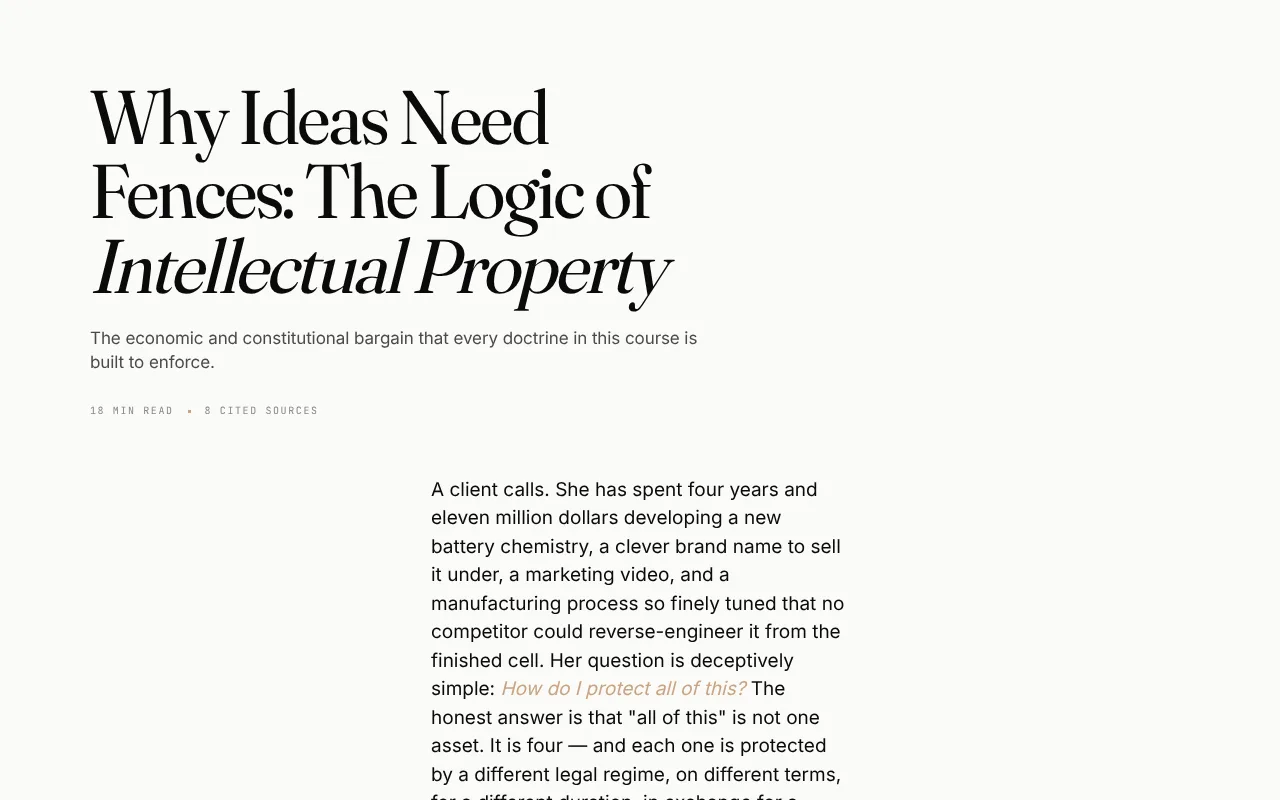
U.S. Intellectual Property Law, chapter 1, captured from the course content in October 2026.
Preview the U.S. IP law curriculum
The opening chapter of the 20-chapter course, as a learner sees it.
Recent updates and treatment of AI/IP developments
Pricing and accessibility
15%
Free vs paid, duration, self-paced and mobile suitability
Credential clarity
10%
Exactly who issues certificates and whether credits qualify
These categories serve different users. We do not claim that a U.S. self-study certificate outranks a university program on academic status, or that a WIPO introductory module gives U.S. practice credentials. Each provider receives a contextual best-for award rather than a made-up global score.
The Best Intellectual Property Law Courses in 2026
We selected paths that represent distinct learning needs: U.S. applied education, global foundations, university-directed study, formal professional CLE and official primary-source learning. Course enrollment terms, certificates and availability can change. Always confirm details on the course provider's current page before purchasing.
1. Wysebridge IP Education: Best for Applied U.S. IP Law and AI Topics
U.S. Intellectual Property Law, chapter 1, captured from the course content in October 2026.
$297 per course; $397 with the certificate track · from the live catalogBoth courses are included in Wysebridge ONE.
Curriculum
U.S. Intellectual Property Law (20 chapters); IP Law in the Age of AI (18 chapters) Verified
Credential
Certificate issued by Wysebridge on the certificate track; not a degree, CLE credit, bar qualification or license Verified
Wysebridge's IP programs aim to connect the rules of intellectual property with contemporary technical and business problems. Its foundational U.S. course covers patents, trademarks, copyright, trade secrets and IP strategy. Its AI-focused program addresses changes in technology that raise questions about inventorship, authorship, ownership, training data and liability. The pairing is useful for professionals who encounter IP issues in research, product development, creative work or business operations.
The principal advantage is educational continuity. Someone can first learn the basic categories of IP, deepen understanding of AI-related issues and, where relevant, transition into patent bar preparation or practitioner training without starting an entirely unrelated learning relationship. That path differentiates a broader education ecosystem from a single isolated short course. Both courses are also included in Wysebridge ONE.
Buyers should still judge the content on its merits. Check the full syllabus, estimated commitment, the free first module and the assessment methods. The certificate is issued by Wysebridge, and course completion does not itself confer USPTO registration, state bar admission or other licensure. Students looking for university academic credit or jurisdiction-approved CLE must look elsewhere or confirm those separately.
What stands out
U.S.-focused IP fundamentals and AI/IP education in one learning ecosystem.
What to weigh
Whether a self-study course or the certificate track fits your goal, and what is included if you buy Wysebridge ONE instead. Course completion is not a license or CLE credit.
Best suited for: Professionals who need a structured, practical introduction to U.S. intellectual property or want to understand emerging AI/IP issues. Also suited to learners exploring a longer route toward patent practice.
Free introductory options; other programs vary · checked October 2026; confirm at checkout
Provider
The World Intellectual Property Organization, a United Nations agency Official source
The World Intellectual Property Organization's Academy is a strong first stop for learners who need to understand IP across national boundaries or who prefer an internationally grounded explanation of concepts. Its educational offerings introduce major categories of IP protection and connect them to innovation, development and international systems. The association with WIPO makes the Academy especially relevant to students working in multinational organizations or considering cross-border protection strategies.
Introductory options can be an accessible way to learn foundational terminology without a large financial commitment. Depending on the offering, students may encounter different languages, course formats and progression opportunities. Those distinctions matter because "WIPO Academy" describes a catalog, not one single course with a universal price or credential.
The important limitation is jurisdiction and purpose. Someone preparing for the USPTO registration examination needs specifically tested U.S. procedural material, not just a global introduction. Someone seeking daily U.S. patent prosecution skills similarly needs narrower applied instruction. But as a way to understand the broader international system and identify areas of interest, WIPO belongs on any serious shortlist.
What stands out
International perspective, a recognized intergovernmental institution and accessible introductory offerings.
What to weigh
Course-specific language, enrollment dates, assessments, costs and the relevance of each syllabus to U.S. practice.
Best suited for: Global teams, cross-border founders and beginners seeking credible IP foundations. Learners focused exclusively on U.S. patent bar preparation should supplement with dedicated USPTO material.
3. University of Pennsylvania on Coursera: Best for University-Led IP Fundamentals
Coursera platform terms; confirm on the course page · checked October 2026; confirm at checkout
Format
Intellectual Property Law Specialization: a four-course series Publisher-reported
The University of Pennsylvania's Intellectual Property Law Specialization provides a university-led path into major IP concepts. Its public description covers patents, trademarks, copyright and strategic use of legal rights in business. Learners complete a set of courses, with applied exercises such as interpreting patent documents, building trademark strategy and working through a copyright dispute scenario.
The university association and the structured series can appeal to individuals who want an academically framed introduction with a recognizable institution attached to the completion credential. Its public learner reviews make the offering relatively easy to investigate independently, although reviews of component courses are not necessarily evaluations of every individual learner's outcome; ratings and enrollment counts change, so read them on the course page itself.
The biggest question is fit. A broad specialization is helpful for understanding the landscape but should not be confused with preparation for the USPTO Registration Examination or a law degree. Course pacing, subscription fees, financial assistance, auditing options and certificate eligibility should be confirmed directly on Coursera, since those terms can differ across students and regions.
What stands out
University-led structure, a clear course sequence and public course engagement indicators.
What to weigh
The specialization is broad and introductory to intermediate rather than a patent prosecution qualification.
Best suited for: Learners who want an academic-style overview and a recognizable university-linked course credential. A reasonable choice for managers, students and career explorers.
4. Practising Law Institute: Best for Attorney-Focused Continuing Education
Varies by program and membership · checked October 2026; confirm at checkout
PLI offers an extensive legal education catalog covering topics relevant to attorneys, legal departments and practitioners. Unlike a single beginner's course, a professional education provider can deliver timely, specialized training across individual legal topics. That makes PLI most relevant when the learner already has a legal background or needs a focused update on a changing practice area.
For intellectual property, the central buying decision is the specific program rather than the brand alone. Review the course faculty, date, jurisdiction, level, stated learning objectives and available practice materials. If CLE is a requirement, confirm that the actual course is approved or accepted for the attorney's jurisdiction and credit category; general statements about provider reputation are insufficient.
The tradeoff is that sophisticated attorney training can assume foundational knowledge. An engineer or early-stage founder learning about patent versus trademark protection might get more from a structured beginner's curriculum. For an attorney seeking a current program in an emerging IP issue, however, a focused professional course can be a better use of time than a general survey.
What stands out
Broad professional legal education and specialized subject matter.
What to weigh
Program-by-program cost, level, enrollment format and exact CLE eligibility.
Best suited for: Practicing lawyers and legal teams with specific continuing education goals. Less efficient for absolute beginners who first need foundational vocabulary and concepts.
5. USPTO and Other Official U.S. Resources: Best for Primary-Source Learning
Public agencies provide essential material on the laws and procedures they administer. The USPTO offers information on patents, trademarks, filings and examination processes. The U.S. Copyright Office offers educational and official reference materials about copyright registration and legal principles. These sources help learners distinguish between actual procedural requirements and oversimplified claims in commercial advertising.
For an inventor or founder, official content can answer concrete first questions: what the right protects, what is filed, what fees may apply and where to find the applicable instructions. For an advanced learner, government manuals and guidance serve as primary references that should be checked against any third-party educational explanation.
What public agencies generally do not offer is a single personalized curriculum integrating patents, trademarks, copyright, trade secrets, AI scenarios, quizzes and career planning. Learners must determine their own study sequence and seek professional advice when facts call for it. Official materials are also not a substitute for legal counsel evaluating a real patentability, clearance or infringement question.
What stands out
Authority, accessibility and direct references to U.S. procedures.
What to weigh
A distributed learning experience and no single integrated student feedback system.
Best suited for: Anyone who wants accurate starting references and specific administrative guidance. Essential supplements for learners enrolled in any commercial IP course.
Side-by-Side Comparison
Scroll the table sideways to see every column.
Intellectual property law courses compared by focus, format, credential, cost and ideal learner
Provider
Primary focus
Format
Credential or credit
Typical cost
Ideal learner
Wysebridge
U.S. IP fundamentals and AI/IP
Online self-study courses
Wysebridge-issued certificate on the certificate track; not CLE or a license
$297 per course; $397 with the certificate track
Applied U.S. and AI/IP learners
WIPO Academy
International IP education
Catalog; varies by course
Course-dependent
Free introductory options
Global beginners
Penn / Coursera
Broad IP specialization
Online four-course series
Course completion credential as stated by Coursera
Platform terms; confirm
Academic-style learners
PLI
Specialized legal education
Program-dependent
CLE only where the course and jurisdiction qualify
Varies
Practicing attorneys
USPTO / Copyright Office
Official law and procedure
Public web resources
None (not a course)
Free access
Primary-source learners
Third-party details read from each provider's site, October 2026; Wysebridge prices from the live catalog. Enrollment terms and prices change, so confirm on each provider's page.
Exam preparation is different from a general IP course
What Real Learning Outcomes Look Like
We do not publish completer stories or employer case studies we cannot document. Instead, here is what a learner should be able to do after a solid introductory course, which is the standard we hold our own syllabus to and a fair test for any program:
1
Classify the issue.
Identify whether an idea primarily raises patent, trademark, copyright or trade-secret questions.
2
Explain a distinction from a real source.
Explain a U.S. patent-versus-trademark distinction and cite the USPTO page that supports it.
3
Spot the uncertainty.
Identify the factual question that decides an AI-generated-work scenario, rather than guessing an answer.
4
Produce something usable.
Draft an IP risk checklist for a fictional startup that a lawyer could review.
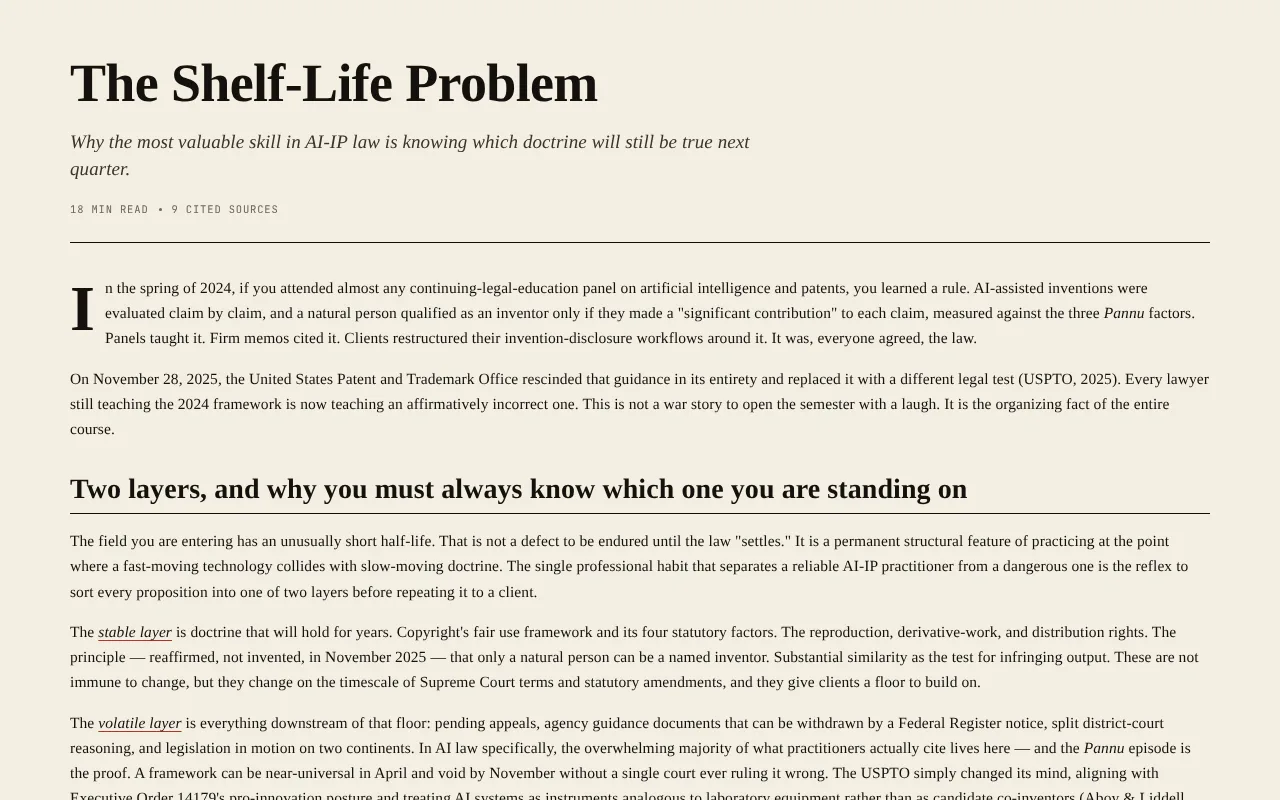
IP Law in the Age of AI, chapter 1, captured from the course content in October 2026.
See the AI course
IP Law in the Age of AI covers inventorship, authorship, ownership, training data and liability across 18 chapters.
What is the best online intellectual property law course?
The best course depends on jurisdiction, prior knowledge and your desired outcome. Compare the actual syllabus, assignments, credentials and cost rather than assuming one brand is best for every learner.
How do I learn patent, trademark and copyright basics?
Begin by understanding what each right protects and what it does not. Then study practical examples and consult USPTO or Copyright Office primary resources for U.S. rules.
What does an IP law course certificate mean?
It usually certifies completion of the provider's course under its published rules. It does not automatically confer a law degree, permission to practice law or USPTO registration.
How is an IP law course different from a patent bar prep course?
An IP law course generally surveys one or several forms of IP. A patent bar course specifically prepares candidates for the USPTO Registration Examination and tested patent prosecution procedures.
What is the best IP course for engineers working with AI?
Look for substantial treatment of patents, inventorship, confidentiality, training data and current AI/IP issues. Review the instructor or editorial process and the update date, because the legal landscape evolves.
How much do online IP courses cost?
Costs range from free official introductions to paid programs and professional education. Confirm any subscription, certificate upgrade, renewal and refund terms at checkout.
How can an attorney earn CLE from an IP course?
Check the course's specific accreditation and your jurisdiction's rules before enrollment. A provider's general educational reputation does not establish credit eligibility for every class.
What should I learn after an introductory IP course?
Choose a more practical path based on your work: invention disclosure, patent search, trademark clearance, licensing, prosecution or AI governance. Use hands-on exercises and primary sources to build applicable skills.
Explore Intellectual Property Law Courses at Wysebridge
Turn IP questions into practical knowledge. Start with the concepts behind patents, trademarks, copyright and trade secrets. Then explore how AI is affecting intellectual property rights and business decisions. Review the complete syllabi and the free first module to see whether the depth matches your goals. Choose self-study or the certificate track only after checking exactly what each includes. If you intend to pursue patent registration, read the separate patent bar buyer's guide as well.
Third-party course details come from each provider's own pages, read in October 2026; we do not quote ratings or enrollment counts that change daily. Wysebridge prices come from the same catalog checkout charges from, and the lesson screenshots are captures of the actual courses. Certificate and credit statements are limited to what each provider publishes. Spot an error? Tell us.