Patent Bar Exam Simulator
Patent Bar Exam Simulator: Practice the USPTO Exam Before Test Day
The Patent Bar is a knowledge test, a research test, and a pacing test. Wysebridge gives you a Prometric-style simulation environment where you can practice full 50-question sessions, work against the same three-hour session limit used by the USPTO registration examination, search the MPEP during the session, flag questions for review, and analyze your performance afterward.
The goal is not to claim that every screen or technical behavior is identical to a Prometric test center. The goal is to make the important exam-day workflow familiar before your actual appointment: reading long fact patterns under time pressure, deciding when to search the MPEP, navigating reference material efficiently, marking uncertain questions, and managing time across a three-hour block.
You can try the exam demo before enrolling. PRO access unlocks the complete simulator library and repeated full-length practice.
- 50-question timed sessions
- AM + PM sessions
- MPEP lookup
- Chapter-level review
- 100
- Multiple-choice questions
- USPTO registration exam
- 50
- Questions per session
- Two sessions: AM + PM
- 3 hrs
- Per session
- Six-hour exam day
- 63/90
- Correct to pass
- Scored questions
Inside the simulator
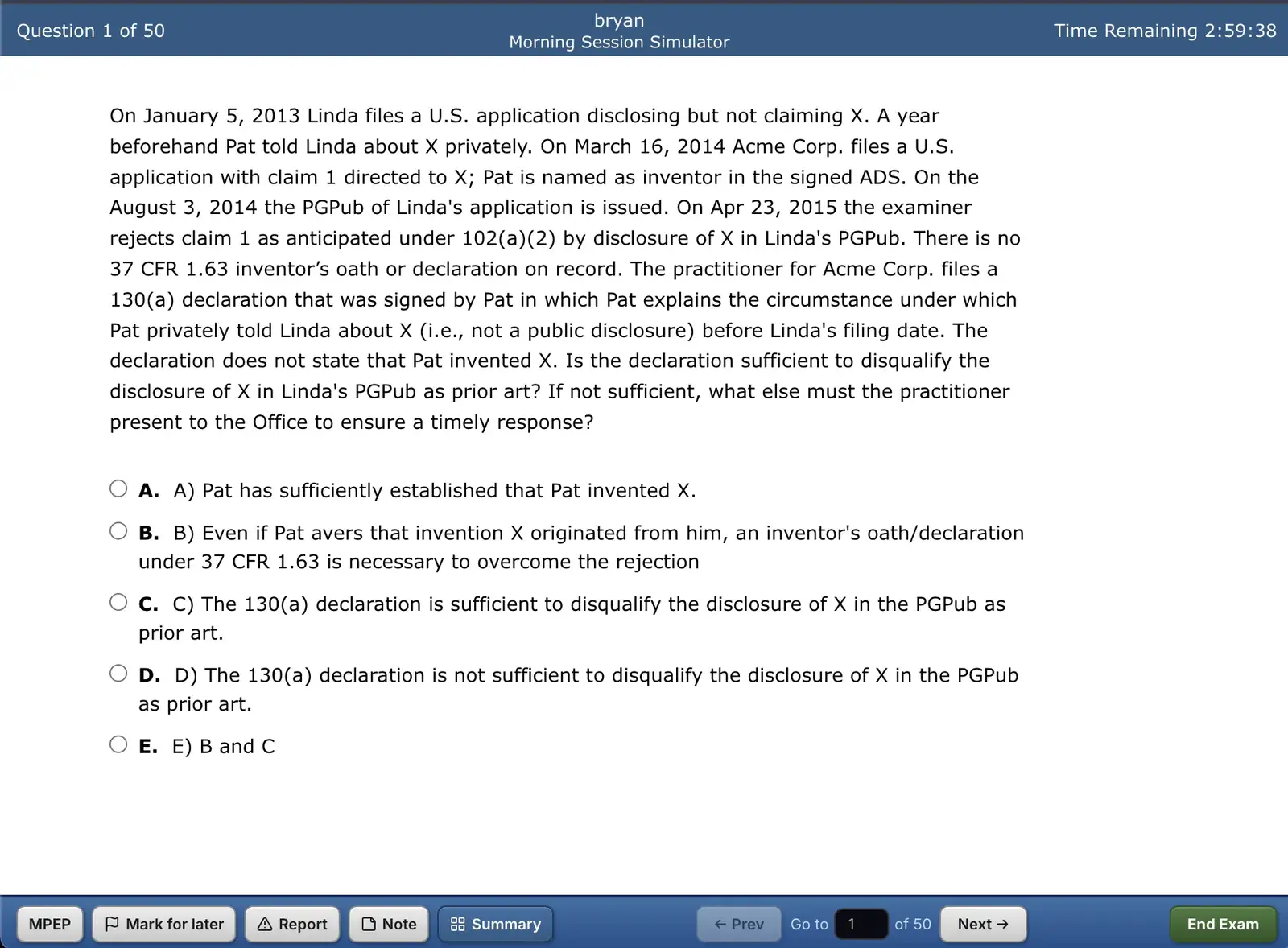
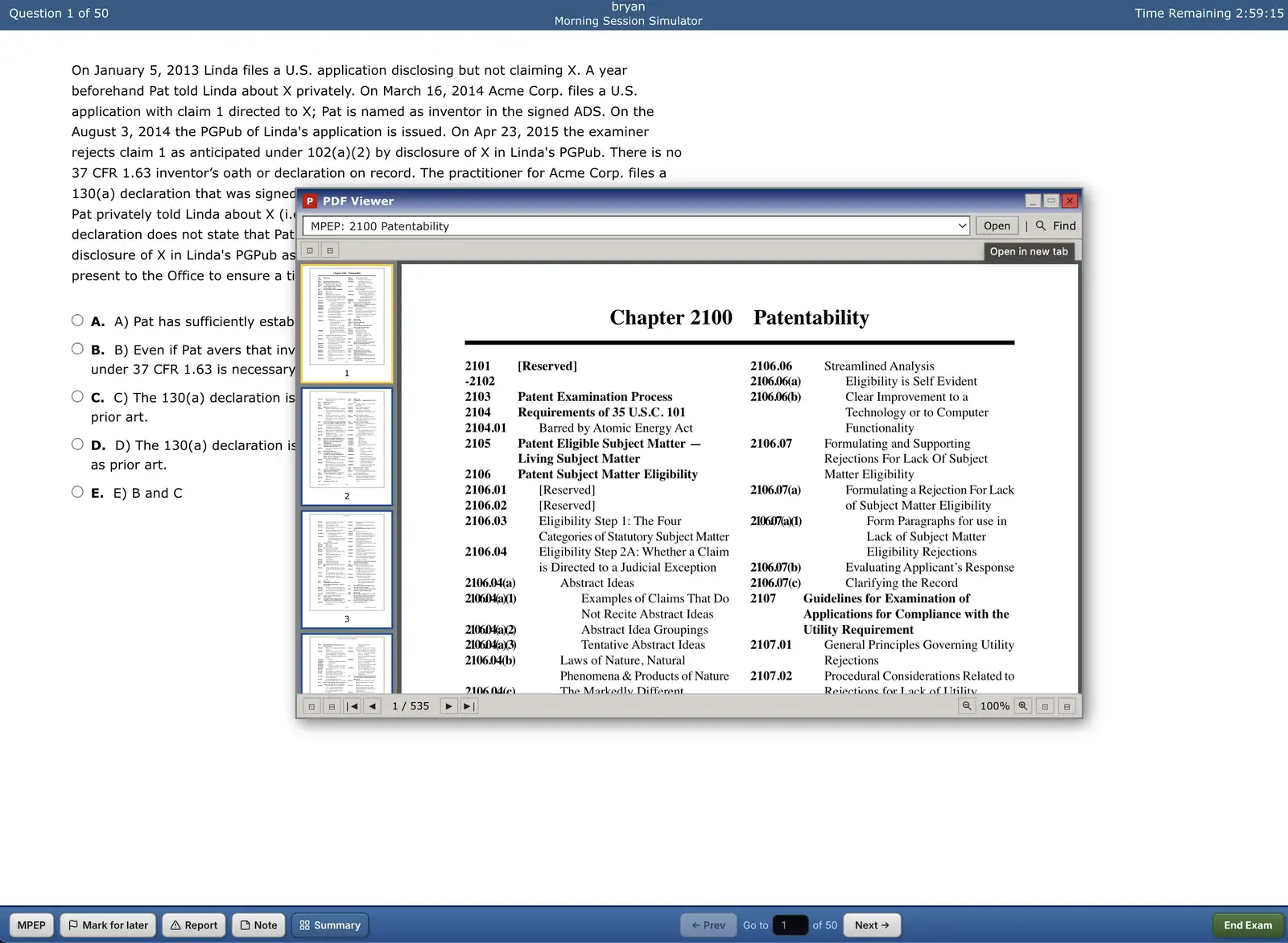
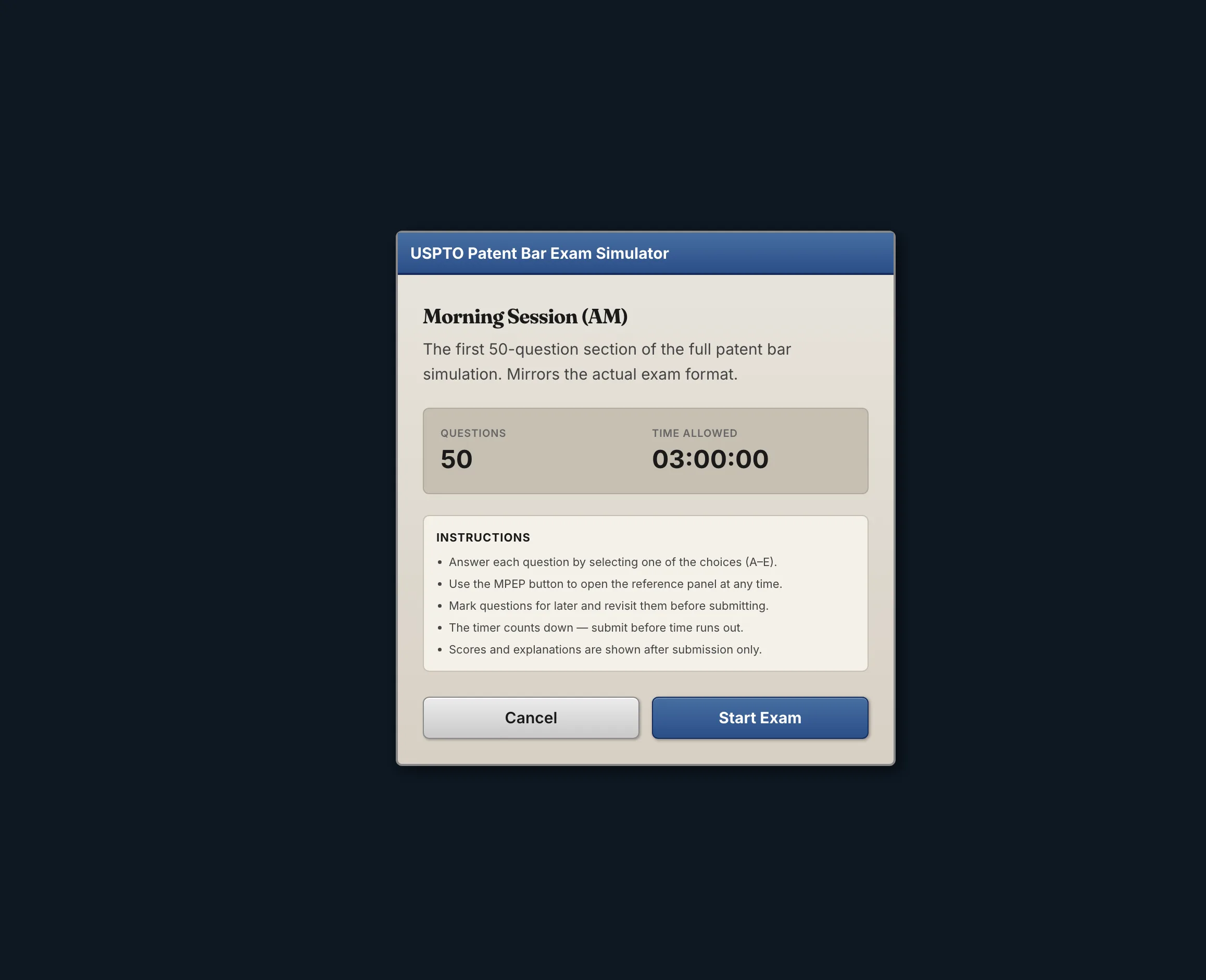
The current exam
What Does the Current Patent Bar Exam Look Like?
The USPTO computer-delivered registration examination contains 100 multiple-choice questions. Ten are unscored beta questions and are not identified. The remaining 90 questions are scored, and a candidate must answer 63 of those 90 scored questions correctly to pass.
The examination is administered in two three-hour sessions, with 50 questions in each session. The USPTO provides the tested reference materials through the examination computer, including a searchable PDF version of the MPEP and other designated USPTO exam source materials.
That structure is why realistic simulation matters: candidates must manage both substantive knowledge and the time cost of reference lookup. For question format and types, see patent bar exam questions.
Simulator features
What the Wysebridge Simulator Lets You Practice
Timed 50-question sessions with a three-hour countdown
Full 100-question practice across two sessions
Question navigation and flagging for later review
MPEP lookup during the simulated session
Released USPTO exam questions presented in exam-style sets
Post-session review with chapter-level performance data
Repeated simulations so pacing and lookup strategy can improve over time
Full-length practice
Practice Full-Length USPTO-Style Sessions
Short practice sets are useful for learning rules, but they do not reproduce the fatigue and pacing decisions of a three-hour session. Wysebridge allows candidates to run complete morning- or afternoon-style sessions and, when appropriate, combine them into a full-day practice experience.
Full simulations help answer practical questions before exam day: How many minutes are you spending on difficult questions? When should you flag and move on? How much time is lost to MPEP searching? Are you leaving enough time to revisit uncertain answers?
To see when full simulations fit into a broader preparation schedule, use the patent bar study plan.
Open book, limited time
Use the MPEP Under Time Pressure
The Patent Bar is open-book, but open-book does not mean unlimited time. The MPEP is too large to search casually on every question. Candidates need to know where common rules live, which search terms are likely to work, and when a lookup is worth the time.
The Wysebridge simulator integrates MPEP access into practice so research becomes part of the exam workflow rather than a separate skill. Use the simulator to practice chapter selection, within-document searching, confirming deadlines or exceptions, and returning to the question without losing your place.
Wysebridge also offers a separate MPEP-search demo for candidates who want to practice the reference interface without running a complete exam. To learn how the searchable MPEP is built, see our MPEP search tools.
Released USPTO questions
Practice With Released USPTO Exam Questions
The USPTO has historically released registration-examination questions and answer keys from older administrations, but modern examination questions are confidential. Wysebridge uses released historical questions as part of its simulator library and supplements them with additional questions intended to cover current law and procedures.
Older released exams remain useful for issue spotting, timing, and MPEP research, but they predate major statutory and procedural changes. They should not be treated as current-law answer keys without updated analysis.
For exam years, downloads, answer keys, and historical context, see the archive of released USPTO patent bar exams. This page covers how those questions are used in timed practice.
Select a full exam
AM + PM · 100 questions
AM + PM · 100 questions
AM + PM · 100 questions
AM + PM · 100 questions
AM + PM · 100 questions
AM + PM · 100 questions
AM + PM · 100 questions
AM + PM · 100 questions
Updated for current law
Current-Law Explanations After the Session
When the law or MPEP has changed since a historical question was released, the explanation makes that distinction explicit. Students need to know what the original answer was, whether the controlling rule has changed, and what source governs today.
Where Wysebridge provides a current-law explanation, it cites the relevant MPEP section (currently the MPEP, Ninth Edition, Revision 01.2024) or other current USPTO source material. Historical question text remains clearly labeled as historical so candidates do not confuse the original exam date with the law currently tested.
After every simulation
Review Performance by MPEP Chapter
A simulation is most useful when the result tells you what to do next. Wysebridge breaks post-session performance down by MPEP chapter so an overall score can be connected to specific areas that need additional study.
Use the report to identify patterns such as:
- chapters producing repeated errors
- questions missed because the rule was unknown
- questions missed because the MPEP lookup took too long
- sections where timed performance is weaker than untimed practice
- topics that improve or decline across multiple simulations
A practice score is a study signal, not a guarantee of a future USPTO result. No simulator can know which of the actual exam questions will be scored or predict the exact question mix a candidate will receive.
72%
Overall score
AM session
36/50
Correct
50 questions
2:48
Time used
of 3:00 hrs
Score by MPEP chapter
Study method
How to Use the Simulator Effectively
- Learn the tested material before relying heavily on full-length simulation.
- Start with a timed 50-question session and record where time is being lost.
- Review every missed or uncertain question against the cited source.
- Use chapter analytics to choose the next targeted study block.
- Practice MPEP lookup separately if searching is still slowing you down.
- Repeat a full-length simulation after the weak areas have been reviewed.
- Track consistency across multiple sessions rather than relying on one practice score.
The complete simulator library comes with PRO
See current Wysebridge plans for plan terms, what's included in Wysebridge for the full inventory, or Wysebridge features for how the simulator connects to adaptive practice and analytics. Just getting started? Try free patent bar prep.
Side by side
How Close Is the Simulator to the Real Patent Bar?
Wysebridge is designed around the major mechanics candidates encounter on the computer-delivered USPTO exam: timed sessions, multiple-choice questions, reference-material access, question navigation, flagging, and deferred scoring. Prometric and the USPTO control the actual test-center software, so interface details can change and no third-party simulator should be treated as the official exam platform.
The practical objective is familiarity with the workflow and constraints, not pixel-for-pixel duplication.
| Feature | USPTO exam (Prometric) | Wysebridge simulator |
|---|---|---|
| Interface layout | Question screen with reference materials | Prometric-style question + MPEP panel |
| Session structure | AM (50 Q, 3 hrs) + PM (50 Q, 3 hrs) | AM + PM, or either in isolation |
| Countdown timer | Yes — per session | Yes — per session |
| Question navigator | Yes | Yes |
| Question flagging | Mark for later | Mark for later |
| MPEP access | Searchable PDF on the exam computer | Integrated searchable MPEP panel |
| In-session feedback | None (deferred to results) | None in exam mode (deferred) |
| Chapter-level breakdown | No | Yes — practice data by MPEP chapter |
| Current-law context | Not applicable | Explanations note where rules changed |
Wysebridge vs USPTO overall pass rate
2012–202581%
Wysebridge first-attempt pass rate (2012–2025 average)
47%
USPTO average (2012–2025)
| Year | USPTO overall | Wysebridge | Difference |
|---|---|---|---|
| 2012 | 54% | 89% | +35 pp |
| 2013 | 47% | 84% | +37 pp |
| 2014 | 43% | 84% | +41 pp |
| 2015 | 48% | 83% | +35 pp |
| 2016 | 47% | 79% | +32 pp |
| 2017 | 43% | 77% | +34 pp |
| 2018 | 47% | 77% | +30 pp |
| 2019 | 45% | 81% | +36 pp |
| 2020 | 49% | 82% | +33 pp |
| 2021 | 45% | 79% | +34 pp |
| 2022 | 46% | 81% | +35 pp |
| 2023 | 46% | 80% | +34 pp |
| 2024 | 49% | 80% | +31 pp |
| 2025 | 46% | 78% | +32 pp |
“I passed the patent bar exam in my first attempt. Wysebridge was the only review that I was relying on and I am really thankful to the Wysebridge team for putting together all the study material in an extremely systematic fashion. The practice questions were very comprehensively covered and the practice test really simulated the actual exam. Overall highly recommended and totally worth every penny.”
Also available
Practice the MPEP search interface separately
The MPEP Simulator lets you practice locating rules, deadlines, and exceptions in a Prometric-style document interface, with chapter navigation, within-chapter search, and a PDF-style layout.
Keep reading
Released USPTO patent bar examsPatent bar study planPatent bar exam questionsFAQ
Patent Bar Simulator FAQs
A complete practice exam can be run as two three-hour, 50-question sessions, matching the USPTO examination structure. Candidates can also practice one session at a time.
Yes. MPEP lookup is part of the Wysebridge simulation workflow. Candidates should practice using the current tested materials and confirm the USPTO source-material list before their examination date.
The simulator includes released historical USPTO questions as well as additional Wysebridge practice questions. Modern live examination questions are confidential, so no prep provider has a public bank of current confidential USPTO exam questions.
No. Older released questions are most valuable for practicing issue recognition, timing, research, and exam-style reasoning. Some rules have changed since those exams were administered, so current-law analysis matters more than memorizing historical answers.
No. A simulator score is useful practice data, but it cannot guarantee an official USPTO result. Look for stable performance across multiple timed sessions and use chapter-level results to identify remaining weaknesses.
Try the Patent Bar Exam Demo
Use the interactive demo to experience the timing, navigation, question flow, and MPEP-research workflow before committing to a plan. For the complete course, question bank, adaptive study tools, and current plan terms, see the patent bar prep course or enrollment pages.